Dignified Farewell

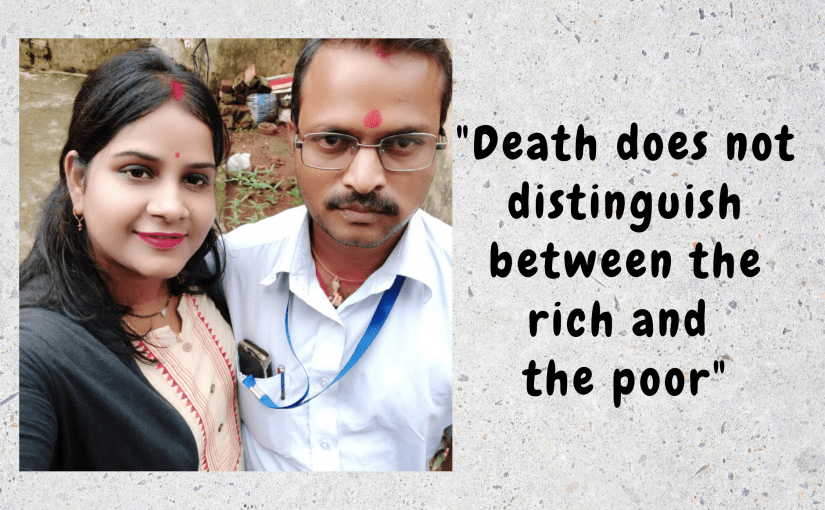
Bhubaneshwar-based Pradeep and Madhusmita Prusty are an extraordinary couple. On most days, their day begins and ends at the local cremation ground. To perform the last rites of unclaimed bodies is the mission of their lives. Be it the recent triple train tragedy at Balasore in Odisha, the Covid-19 pandemic or even during perfectly normal times, the Prustys have been doing their bit for society. Selflessly. This is their story.

….

Deepika Sahu

On a typical day, Bhubaneshwar-based Pradeep and Madhusmita Prusty get a couple of phone calls from local police stations. It is their call for duty. After making all the necessary arrangements for funerals, they rush to the local crematorium to perform the last rites of unclaimed bodies. To give a dignified farewell to people who don’t have families to do the needful is the mission of their lives. Their story is about courage and grit.    

Be it the recent triple train tragedy at Balasore in Odisha on June 2, which, as per the official figures, claimed the lives of 291 people, the many waves of the Covid-19 pandemic and even during perfectly normal times, the Prustys have been doing their bit for society. Selflessly.  

Prusty, 48, was always interested in social work. “My younger sister and I studied in the old city of Bhubaneswar. Our school was near a hospital and we used to go to a shop near the hospital to buy chocolates. We used to interact with the relatives of the patients.” That probably was the beginning of the journey.

The turning point came in the year 1980 when Prusty was just five. His mother died by suicide on a railway track and the family had no information about her for four-five days. That was one of the most traumatic experiences of his life. “It was then that I decided to give a dignified farewell to people in the event of death,” says Prusty, who has earned his living in his adult years by doing many odd jobs like working as a construction worker and selling vegetables.  

The circumstances of the death of his mother and the trauma associated with it never really left him. That also made him realise the importance of the task he has undertaken. In 2014, he started the Pradeep Seva Trust along with 11 of his friends as trustees. He was 39 years old at that time and since then there has been no looking back for him as service has become the core of his life. 

Between 2014 and 2016, Prusty drove an auto. He used the same auto to take unclaimed bodies to the crematorium. In 2017, he decided to get a van as it was becoming too difficult to carry the bodies in an auto. Finally, in 2020, the trust members contributed some money and he got a bank loan to buy an ambulance. “I have to pay the EMI for one more year,” he says.
Sharing his experience of working during the recent train tragedy (June 2, 2023) in Odisha, Prusty says: “We went to the tragedy site the next morning. It was a tough experience because of the massive scale of the tragedy. It was very hard on our team members too. After that, we did volunteer work at Cuttack. We also helped in the post-mortem cases at hospitals as the pressure was too much.”

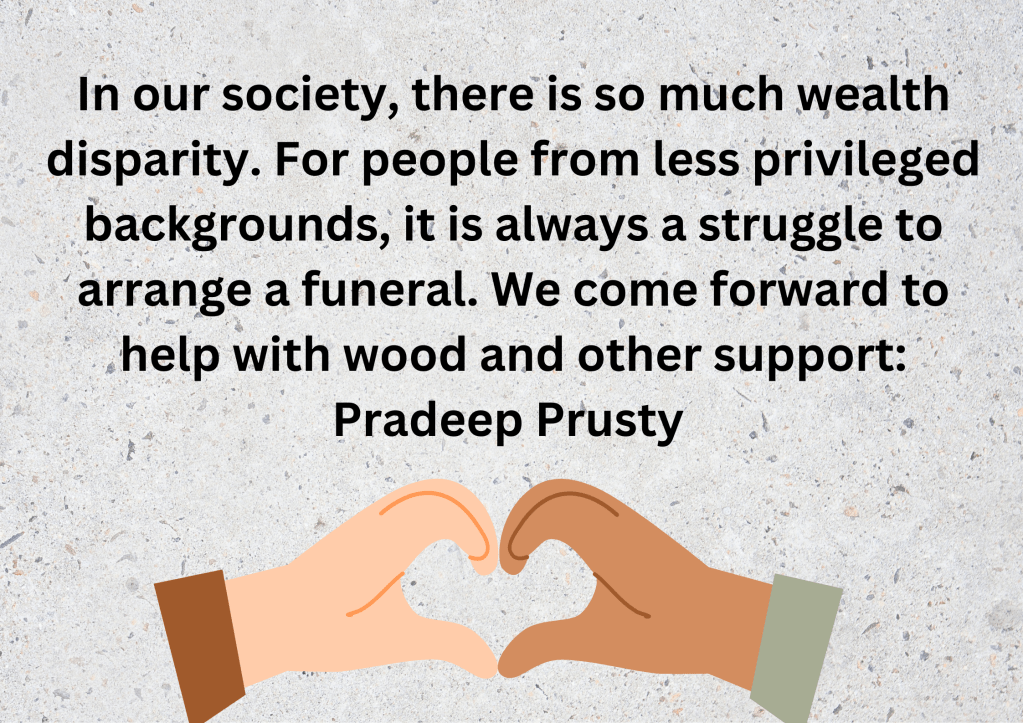
The volunteers at the Trust swing into action the moment they get a phone call from the police station. “We chip in whenever someone calls up for help. In our society, there is so much wealth disparity. For people from less privileged backgrounds, it is always a struggle to arrange a funeral. In that case, we come forward to help with wood and other support,” he says. 

Prusty feels that his work would not have been possible without the active participation of his wife, Madhusmita, 38.“Once while picking up a dead body from the railway track, my leg got fractured. I could not work and it was a tough time for me. Seeing my situation, my wife came forward to help me. It was incredible that a woman came forward to do this. I can’t thank her enough for her courage and sense of service,” he says.

She was working in Chennai as a nurse and was paid well. But in 2019, she quit her job to join the Pradeep Seva Trust. How difficult was it? Was she scared? “Birth and death are the only truths of life. How can I be scared of the truth? Initially, it was tough but it has been a life-altering experience; especially during the Covid-19 pandemic, when family members shunned their loved ones, I came forward to do their last rites. There were many who did not even want to come anywhere near their departed family members,” she shares.

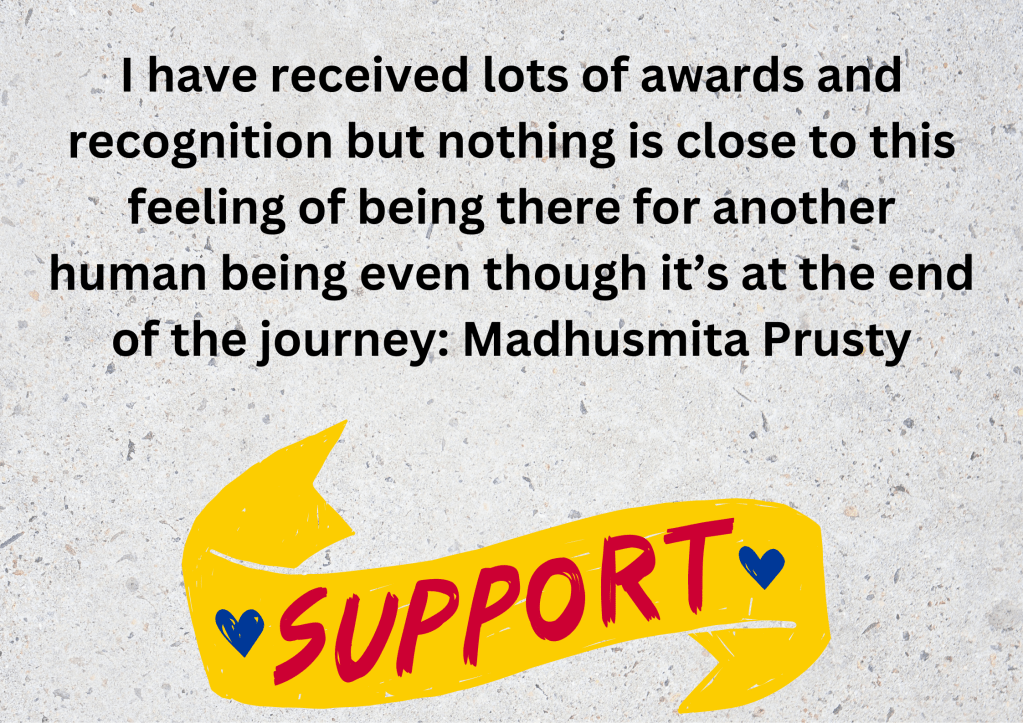
To give the dead a warm farewell in the midst of a raging pandemic was a soul-elevating experience for her. “I have received lots of awards and recognition but nothing is close to this feeling of being there for another human being even though it’s at the end of the journey,” she says.
It’s not easy for a woman to be engaged in this work. How has been the reaction of people around her? She laughs and says: “There are some people who still come to my house for some work or the other but they won’t have water in my house. Recently, an educated person came to my house and asked me, ‘Are there ghosts in your house?’ And then there are people who ask me what’s the need for me to do this work when I come from a decent background?”

The couple has sacrificed everything for this work. 

“There are times when I have to leave family gatherings and functions because there is a need to rush to work. However, I have absolutely no regrets. Right now, we have an all- women’s team comprising five members. They are doing incredible work and it is deeply satisfying and liberating to see them work,” says Madhusmita, a mother of two—a son and a daughter.

Sharing her greatest learning, she says: “Death does not distinguish between the rich and the poor. I believe in the dignity of life and more importantly, I believe everyone deserves a farewell at the end of the journey.”   

Technology has been of great help in their work. They are happy and proud that even though they have not received any assistance from the government, the trust members and their friends and acquaintances have always come forward to support them monetarily whenever they are in dire need. They just share a message on WhatApp and people come forward to help according to their ability. But, at the same time, because of limited monetary resources, they face a lot of constraints. They need more stretchers and gloves so that the work process becomes smoother.

How do they see the future? “We will keep on giving our services whenever there’s a need. When a person has nobody, we come forward to stand with that person … even if we are talking about death here. We become the family member of that dead person in the absence of the family. We have only love and a sense of service in our heart,” says Pradeep.

Deepika Sahu has been a journalist for 28 years. She has worked with some of India’s leading media houses like the Press Trust of India, Deccan Herald and The Times of India. Right now, she is independently engaged in content creation and curation.

Twitter: @menondeepika, Instagram: @moodydeepika Facebook: Deepika Sahu

“Disrupted adoptions have gone from being very rare to over 1,000 children in the past five years”

Says Sangitha Krishnamurthi, a special educator and adoptive parent. In this essay, she talks about some of the aspects that are often pushed under the carpet when talking about adoption and the need to move beyond a simplistic understanding of adoption to help avoid some of these disruptions.

Photo by Pixabay on Pexels.com

Adoption is everywhere and it is nowhere, at the same time. The fairy tale of a child finding her family results in an ‘aww’ leading into a happily ever after. 

The perception is that once a child is placed with his/her family, the job is done, and everyone lived happily ever after.  In reality, the movie is just starting.

November is Adoption Awareness Month and I write this to talk about the lesser spoken aspects of adoption that we should be aware of. 

And what are these? First, adoption is not charity, it is parenting.  With that, this concept of being the same or different just dissolves.  No two children are the same and that’s the whole point.  Second, different isn’t a bad thing.  Third, children know, and the body remembers, even when the mind is just developing. With these foundational principles, I wish we would all talk more about the following.

Parent preparation – it’s vital and it’s missing

In India, parent preparation is next to nil.  It is not mandated by the government and even when it exists, the material is far from adequate.  The approach usually is one of ‘not scaring away parents’ in order to ensure placement.  Anyone who is going to get scared might not be a good family is a point to be considered. 

Unfortunately, many parents who end up being ambassadors for adoption only speak from one point of view – the one they have seen parenting their one or two children. Many minimize the differences so that parents ‘won’t get scared.’ Professionals who are adoption-informed are few and far in between. 

It would be good for aspiring parents to seek out resources on their own, read books like The Family of Adoption by Dr Joyce Maguire Pavao to learn about the adoption triad and speak to as many adoptive families and adoptees as they can so that they can learn and inform themselves. 

Adoptive parenting has some twists and turns that anyone aspiring to adopt should be aware of.  This starts from when the child comes home, taken away, yet again from everything they know.  Adoption begins with grief and loss. 

A mother and father lost out on parenting and a child was wrenched from his/her biological connection.  The adoptive family stands on this foundation.  This isn’t a question of good or bad, positive or negative. This start comes with several consequences that the adoptive family will have to recognize, accept, and accommodate in their parenting.

Photo by Parij Borgohain on Pexels.com

Other questions to consider include using positive language to talk about adoption, how to tell the child the facts of their adoption, how to handle societal stigma, what to share about the child and where, how to get ourselves to a point that we accept that the child is adopted, how to be secure as a parent so that one can take the teenage years with this added facet on top of expected turbulent times, what it means to not have even one biological relative (those of us who can trace back to our great-grandfathers will never know what this feels like!) and how to put our needs aside with the child in the center, however much that hurts at times.

Understanding birth trauma, attachment, and core issues in adoption

It is important for adoptive parents to be conversant with these concepts. Children born of well fed, middle to upper class families, with access to good health care at all times, start off with the advantage of the birth lottery.  A large number of children who are placed in adoption start off premature and/or with low birth weight or ‘failure to thrive’ written in their medical records.  This may impact parenting, schooling, and independence as an adult.  None of these are likely to be major issues, if supported from a young age. 

Children whose first attachment has been disrupted need that much more support when attaching another time with the adoptive family.  In between, the child is in institutions, sometimes in foster care.  At every point, when a bond is being formed or has formed, something changes, and the child is with a stranger yet again.  A child is likely to be moved three times at a minimum and more times than that, in some cases.  Science now tells us that secure attachment is critical to healthy development.  When attachment is ambivalent, children internalize that change is bad, that they need to be on guard.  This shows up in many ways and needs supportive parenting.

Research has found seven specific core issues that adoptees deal with through life.  These are a sense of rejection, loss, grief, guilt/shame, control, identity, and intimacy.  These are recurring strands through their lives and many adoptees have spoken of how it is only possible to mitigate the impact, never eliminate it.

The good news is that our brains are plastic and any changes that have been caused from traumatic incidents can also be significantly compensated for by a loving, caring and knowledgeable environment. As with everything, that first step of informing ourselves in order to understand and then adapt our parenting is critical.

Managing societal expectations and tackling biases and prejudices

Our society is strange.  At the beginning, parents are idolized as heroes who ‘rescued’ a child who is ‘lucky’ to have found a family.  Then, as issues surface from early childhood nutritional differences, the same family is blamed for not being strict enough or too strict. 

With the whitewashing of the differences comes no understanding and support for the parents at the center.  Our schools and teachers often have no idea and many times, mental health professionals have no clue.

Even very experienced psychiatrists and psychologists push back at adoptive parents, saying there is likely no impact from this aspect.  That there is no need to tell the child about his/her adoption because “he/she is now home and being given all the love”. 

Extended families may ask whether the child is of another religion and what we would do if ‘bad’ genes were to be in our child.

Many quasi-experts try to ‘normalize’ adoption.  Adoption is not and should not be our norm.  Making it normal in any way means accepting that we cannot support our families to stay and parent their kids.  While their intentions are good in trying to destigmatize adoption, their efforts end up doing more harm than good in perpetuating this image of the model adoptee, achiever adoptee, no-step-put-wrong adoptee and this fairy tale family which lives happily ever after.

Schooling and different needs

Schools and society are cut from the same fabric, one influencing the other.  So, we have teachers who will not intervene in bullying that tells an adoptee that his/her mother is probably a prostitute and that he/she was thrown in the garbage for being dark and ugly.  All bullying hurts and then this hurts right to the core of the primal wound, one that formed from the separation from the birth mother.

Nutrition early in life is the foundation to significant parts of a child’s development.  When this is hindered, one cannot know how these gaps in development will show up.  Many children with this background may end up with issues in academics, behaviour, etc. 

Photo by Ivan Bertolazzi on Pexels.com

Children with trauma are overrepresented in several developmental differences including different learning needs.  Many, many adoptees emerge with invisible wounds from schooling.

Our teachers may not know about the impact of trauma. Our attitude to differences in learning and behaviour as a society is judgmental. We need to work on changing this.  

The point?

The point of this article is to say that despite all this, most adoptive parents would adopt again. And do.  The intention is to be more informed in ways that matter in order to support our children. 

We need to evolve beyond a simplistic understanding of adoption.  We have a long line of aspiring parents waiting on lists for their children to be matched.  We also have children being returned, based on policies that aren’t thought through.  Disrupted adoptions have gone from being very rare to over 1,000 children in the past five years. One main reason is ‘adjustment issues’ with older children. 

Experts tell us that we are looking at years to adjust and here, we have parents who entered into adoption thinking everything would sort itself out in weeks. Some children are placed again within a few months in another home, layering trauma upon existing trauma.

Adoption is a wonderful way of building a family.  At one level, the parent needs to know that it is parenting, no more, no less.  With attachment, separation trauma and core issues, the parent needs to embrace the difference and work with it.  When teenage and its angst comes along, the same parent needs to see the ‘sameness’ with all children and recognize the differentness of the adoption strands that twang with hurt.

All children are our children, it is our responsibility as a collective to support everyone who needs it. Adoptive families need a level of informed care and support in order to emerge on the other side of their parenting.

You can read more of Krishnamurthi writing at www.lifeandtimesinbangalore.wordpress.com where she has been blogging at for the past 11 years now.