William’s mother Bharati D’Souza was 76 when she left the world on November 1, 2022. Before she was diagnosed with Koch’s disease in 2010 which affected her spine and rendered her bedridden, Bharati was very active. For William, a Mumbai-based journalist and communications professional, and his family, the next 12 years were all about learning and unlearning, but mostly about caregiving. After Bharati passed away, William and his wife Zarine decided to share their caregiving journey to help all those who might be taking care of elderly, dependent parents
…..
My mum’s journey was incredible. She was born in Secunderabad in 1946, around the corner from Paradise theatre—an area that later was known for the world-famous Hyderabadi biryani. Quite ironic, because my mum remained for her entire life a vegetarian; at the very most, an ‘eggetarian’! But mind you, she was a good cook of non-veg dishes, which she learnt from my dad, Conrad, without ever even tasting them! In return, dad always publicly complimented her South Indian cuisine, saying: “I never knew there were so many different types of dals and rice!”
When dad passed away in 1990 aged 64, it fell upon mum to raise me, 13, single-handedly, which she did commendably. What helped in this challenging journey was her extremely determined, and maybe stubborn character.

One example of her determination was when she met with an accident over five decades ago in New Delhi. As mum and other pedestrians were crossing the road, a speeding, possibly drunk, truck driver rammed into a taxi halted at the traffic signal that went over her right foot. She was rushed to Safdarjung. The foot was crushed so badly that doctors were almost going to amputate it. But since she was in her early 20s, they decided against it.
After several reconstructive surgeries every alternate Tuesday, the medical team managed to restore it. They gave mum at least three years to walk, if at all she could. She did it in about six months, with calipers. Ultimately, she worked off those calipers, too, and just needed padded shoes specially made for her for the rest of her walking life.
Mum initially followed in her father’s footsteps and tried a short tryst with journalism. But it was the hospitality line that beckoned her. From 1966 to 1970, mum was in Oberoi’s staff in Delhi, and following that for over 17 years she was at what was then one of the grandest places to party—ITDC’s The Ashok Hotel in Delhi’s tony Chanakyapuri. That’s where mum saw a lot of VVIPs—from both our Gandhi PMs to Gorbachev, from Bollywood to Hollywood stars, from cricketers to cosmonauts. She also met the BoneyM group, and even The Beatles!
The Turning Point
Before she became bedridden, mum was always a blur. Ever on the move, ever busy, no time to stop and rest. She was extremely active.
Around 2009-10, she started losing weight. On checking, the doctor put it down as UTI. She had back pain and was getting physiotherapy done. Heat packs were giving her only temporary relief. The real reason was Koch’s disease—a type of TB that affects any organ. It affected her spine and weakened her D4 to D6 vertebrae. Due to this, she was paralysed and even lost all sensation from the chest down.
That was end-2010. By the time we could get the corrective surgery done, it was too late. Two surgeries and an implant later the doctor gave her a 20 per cent chance of getting back on her feet. But it was not to be. She was immobile but not incapacitated. Still, our lives changed.

Our Caregiving Journey
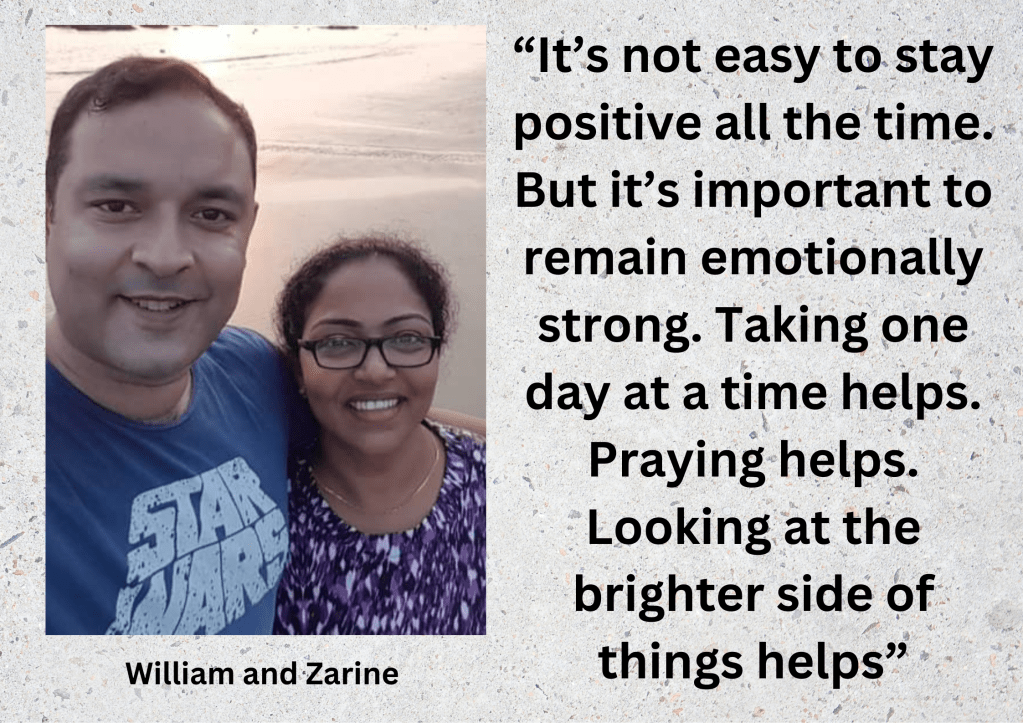
It’s not easy to stay positive all the time. But it’s important to remain emotionally strong. Taking one day at a time helps. Praying helps. Looking at the brighter side of things helps. There are days when things become very low. The first indication is patience running out. It’s then you must think of the more positive things, perhaps amazing memories, going through a family photo album—things which connect you to a more pleasant memory and help you keep the dark thoughts aside.
It’s not easy to juggle between professional lives, young children, managing home as well as taking care of a dependent parent. Time management is important. The unwell person takes priority. Once they are taken care of, fed and rested and they do not have to be attended to, at least for some period, that gives them the feeling that they are important and is good for their positivity.
The children have to be told that they can wait their turn and they will be taken care of. The children, too, can help around and should be asked to, like helping with small things like bringing to the patient water, or a book or a newspaper. They can tell their day’s activities and make the patient feel involved in their life. This way, the caregiver gets some time to do other chores, like going out to the market.
Even small things like spending an evening out, taking a weekend break or going on a holiday need to be thought through. For us, even a trip to the movie theatre was a huge deal. And if, by some miracle, we managed to get the attendant to stay for a few days, our holidays would be to nearby places to allow us to quickly dash home in case of any emergency.
In such cases, planning a holiday is akin to event management! The food has to be home-cooked, so search and try out beforehand a source that gives fresh, healthy meals. There should be a known nurse on call. Then you need a 24-hour maid who is known to the person. Neighbours or nearby friends coming and checking on your homebound patient is also a must. But it’s doable. We managed. So could you.
Having said that, the credit goes to my wife, Zarine. In our society, traditionally, women are expected to be the caregivers. I would say my wife did 99% of the caregiving and management. I only did the heavy lifting where required and threw money at the problem. All of that was quite useless if my wife was not who she was—an unbelievable daughter, more than a daughter-in-law. Thanks to her, I was able to devote time to my job.

“Once you get your time management in order, everything falls in place. Mummy was comfortable with me, so she liked me taking care of her. I had a maid who would come in for eight hours – 9 am to 5 pm daily. On the nights that I needed a break, I would get in someone from 8 pm to 8 am, too. Covid was tough though. We didn’t get any help,” says Zarine.
She is a home baker who works under the brand name ‘Magwiza’—an acronym for her children Mark, Grace, Willie and Zarine. It was her mum-in-law who encouraged her to start baking. In the housing society gatherings, Zarine would set up a stall and mummy would play the cashier.
Whenever Zarine needed a break, she would bake. “I am a stress baker. The weighing of ingredients and the mixing of the batter gave me my ‘me’ time. I would take up whatever orders that I could manage and would not overload myself with work. This ensured me the joy of baking.”
It is difficult to juggle between so many responsibilities. “There are days when you are completely drained, and the night seems like it will not end. Then it’s all prayers. You have to be grateful and thankful for all that you have.”
Do friends and relatives pitch in? “They can help by just enquiring and staying in touch. Some of my friends used to make it a point to visit my mum or at least call whenever we had to go out on unavoidable trips. Thanks to them we could even take some week-long trips every few years,” says William.

Despite all the help, taking care of a dependent person is a 24×7 task. Even more difficult is to deal with the universe-sized vacuum that gets created after the person is gone. What were the coping mechanisms? “After 12 years, I felt I had so much time on my hands. I could do everything and still had time left. I got involved in school and church activities and renewed my efforts towards baking. Knowing that now Mummy is in a better place gives me consolation,” says Zarine.
After D’Souza passed away, William and Zarine got many requests from friends and family to share their caregiving journey which could help others in a similar situation. “That’s when I shared a few pointers on LinkedIn and got a very positive response. We are open to sharing our journey and helping others,” says William.
***
Here is the shortened version of the 20-pointers that William shared on LinkedIn. The last one is the most important, he says.
1) Get help: It’s not cheap. We started with a maid for 10 hours for Rs 275 a day in 2011 and by end-2022 this had shot up to Rs 500 for eight hours daily. And these are just those ‘mowshis’ you get in hospitals to bathe, clean beds and feed patients.
2) Have a nurse/medic on call: Bed-ridden patients may need catheters. Their urine bags need regular changing. You will need professional help. In 2011, we were spending Rs 500 per visit. Gradually, my wife started observing closely what nurses did and she trained herself to change catheters on her own.
3) Look for cheaper equipment: Identify wholesalers for under sheets, cotton, gloves, masks, medicines like powders, anti-septic etc, and even catheters, urine bags and distilled water to flush them. The first time we learnt this was in 2010 when an under-sheet cost Rs 75 each at the hospital. A quick check with the supplier’s address and we managed to get 100 such sheets for Rs 1,500 total.
4) Lease model: Don’t buy outright if you want to save funds. Whether it’s a hospital bed, wheelchair or other medical support paraphernalia, the lease model requires you to give the supplier a lumpsum amount that in most cases reduces over time. The lease model helps when you do not know how long you need the equipment.
5) Bed/mattress options: If you can afford it, an automatic hospital bed’s fine. But a mechanical one with the hand crank served us superbly. Do not use your existing bed/sofa because it’s tough to raise the patient for meals and then lower them again. Always go for the hospital beds. Avoid water mattresses. The best is an air mattress.
6) Exercise is vital: Lack of movement causes massive muscle loss. Legs wither away, and overall limbs take on a skeletal look. So, get going on those exercise routines. Get a physio, at least initially, to learn all important exercises.
7) Curse of bed sores: You can only take steps to minimise these. The only way is to turn the patient every two hours. Bed sores are known to form in just one night of not moving a patient but take over a year to heal. Do not take any risk. You just have to set an alarm to turn patients who are bedridden and ensure they are never lying in one position for more than a couple of hours.
8) Take them out! If the patient can be lifted and moved, at least once a week put them in the wheelchair and take them out.
9) Get PoAs/Will made: Becoming bedridden means just that, becoming immobile, and next of kin will have to step up to take the place of the patient in all family and legal matters. So, you should aim to have a unanimous call taken within the family as to who gets a power of attorney (PoA) and for what purpose, as soon as possible (being the only child, I ended up with half a dozen PoAs). Get a will made too.
10) Have a foldable bed table: This is multi-purpose—not only for food but for patient’s writing, or keeping mobile/tablet for personal entertainment, etc.
11) Keep them busy/entertained: My mother could feed herself and even took up my children’s studies. That was an immense help in keeping her occupied. But she was also an avid reader and fairly active on her mobile. She also loved Sudoku and puzzle books. So, we got her those too.
12) Bathing: The maid would give my bedridden mother a sponge bath daily. Then every Saturday (my offs), we would lift her from bed to wheelchair, wheel her to the bathroom, then lift her from wheelchair to plastic chair, where the maid would bathe her. This was followed by the return to bed by shifting her back exactly in reverse. But the bathroom door is narrow in most apartments, and even though we widened our bathroom doorway, it was still just enough for only one person to lift mum up from the wheelchair to the plastic chair inside. That was me! Soon I got a backache, sometimes so bad that it would lay me low for two days.
13) Haircut/nails/teeth: The best is to do all hair-cutting and nail-cutting yourself. Bad oral care is just best avoided in case of a bedridden patient.
14) Have lots of table space near the pillow/head as well as near the feet: You never know when the patient requires a BiPAP machine for better breathing or a nebuliser. The pipelines are not too long. So, these need to be set near the patient only on a stool or some platform.
15) Voice-activated/smart/remote-controlled switches: Have multiple plugs or an extension cord fitted near the patient’s bed because you will need lots of powered equipment like an air mattress, mobile charging, breathing machines, etc. A great help nowadays is to have some smart speakers or WiFi/remote-controlled switches around for the patient to become independent.
16) Maintenance/backups: All equipment fail, especially since they will be working 24/7 for the patient. So, keep temporary backups ready.
17) Power of prayer: Never ever underestimate this, especially when it comes to senior citizens, who unfortunately make up most bedridden patients. I am not talking about healing, but the faith this builds in patients and helps them in their daily activities. So, ensure that the patient knows what online sites to visit for pujas or masses.
18) Get disability certificate and look at Sec 80D: It took me three years to learn about permanent disability certificates. She was certified 90% permanently disabled. How does this help? Under current tax laws, over 40% disability gets the caregiver a Rs 75,000 tax sop per annum, and over 80%, it’s Rs 1.25 lakh. Below 40% does not count. If the certification is not “permanent”, you will need to renew it every five years.
19) Keep morale high: The patient will lose morale. It’s a given. No problem is worse than a patient losing all hope. Then you have to step in. The trouble is, you have to do this while motivating yourself to take care of them.
20) Take care of yourself: It’s no joke to get a call at 2-3 am for a glass of milk with biscuits, especially if the patient is diabetic. It’s extremely tiring not being able to go anywhere for a break. And remember how I had nearly broken my back? Please learn to find alternatives. Invest in your emotional and mental well-being. Take rest. Also, once in a while, do something fun.
…..
Want to share your story? Write to us at contactgoodstories@gmail.com
Also read: I lost my ma to covid , I lost my wife during the 2020 lockdown ,

 The Good Story Project