The beginning of a new year is the perfect time to reflect upon the year gone by. When journalist Saurabh Sharma looks back at his last year’s professional journey, one assignment stands out. It wasn’t just a story. It was an experience that touched him personally. When he went to cover the Uttarakhand tunnel tragedy, little did he know that he would come back with a bagful of unexpected episodes of kindness
Swati Subhedar
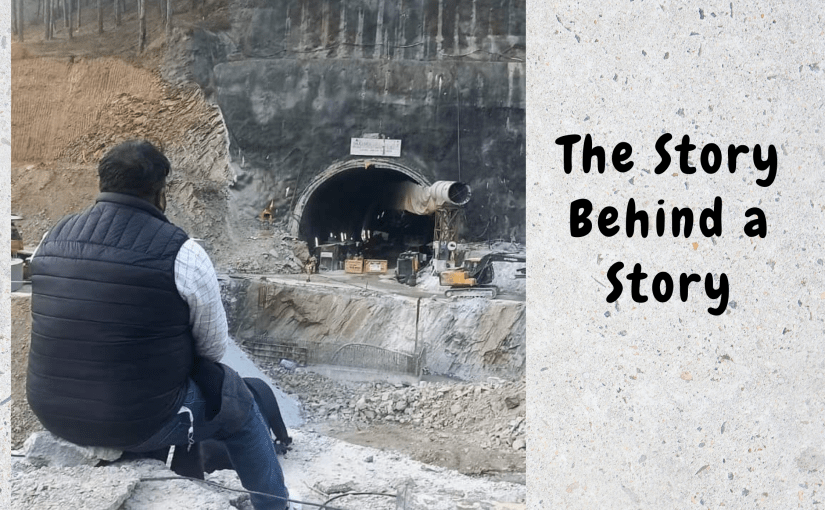
It was a classic tale of tussle between humans and nature. On the morning of November 12 last year, the day the entire nation woke up all set to celebrate Diwali, at 5:30 AM, an under-construction tunnel at Silkyara-Barkot in Uttarakhand collapsed, trapping 41 construction workers inside. The tunnel was being constructed as part of the Char Dham project, intended to connect important Hindu pilgrim sites in Uttarakhand, with two-lane, all-weather paved roads.
Given that the incident happened in the ecologically fragile Himalayan region—prone to such incidents because of the incessant drilling of mountains to construct roads—it was anticipated that tunnel rescue might take longer than initially anticipated. Breaking news soon turned into a constantly developing story. A slew of journalists started arriving at the collapse site. Among them was Saurabh Sharma from Lucknow.
Silkyara is an important connecting point for tourists going to Yamunotri, one of the four destinations of the Char Dham Yatra. The holy shrines of Char Dham open every year with the advent of summers in April-May and close with the starting of winter months of October-November. So, when the tunnel collapsed, most of the hotels, restaurants, home stays and dharamshalas, that host incoming tourists during the peak season, were closed, or were winding up. Most of the owners had moved to their homes in Dehradun, the state capital, and other cities in the plains as it was the beginning of the off season. The others were packing up.
The journalists, who could not miss even a minute of coverage after the rescue operations began, were facing logistical issues like food, transportation and accommodation. While some stayed at one-two hotels that were still operating, it wasn’t much of a help because these were functioning with less than half the staff strength. Most reporters went back after the initial coverage. Very few, including Saurabh, decided to stay till the end of the rescue operations. At that point in time, no one knew that it would take 17 long days.
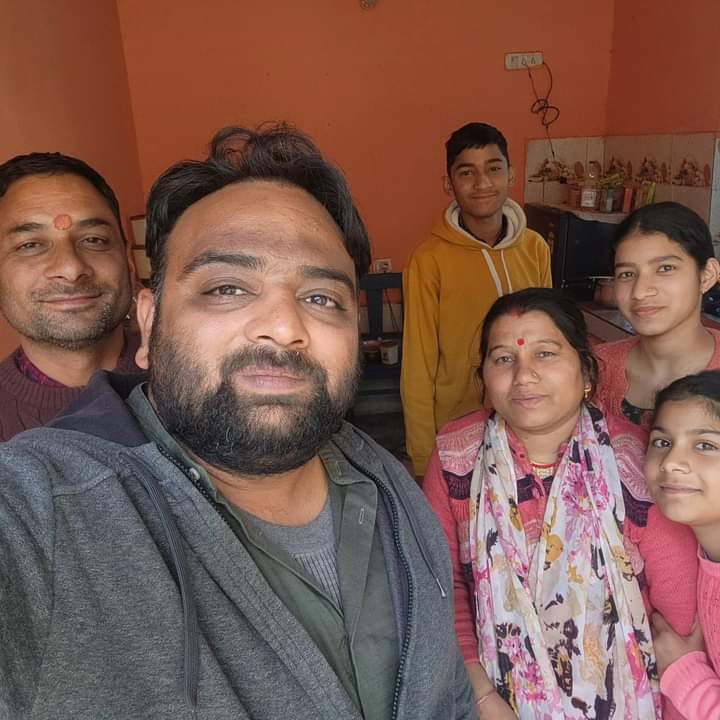
Saurabh Sharma with the Vidhan family
Saurabh was fortunate to meet the Vidhan family when he arrived in Silkyara. The family owns a modest eight-room homestay with minimal facilities and a common washroom. They were also packing up for the season but decided to let him stay. Saurabh, who thought it would be a short trip, wasn’t prepared for a long stay. The very first problem he encountered was that of laundry. The nearest market area was two hours away and it wasn’t possible for him to leave the collapse site even for a few minutes. So, he asked Mrs Vidhan if there were any laundry facilities around—a common practice in the hills where tourists are allowed to wash clothes in public washing machines in exchange for a small amount. Everything was closed. “She told me not to worry and said she would wash all my clothes in their washing machine. I was very hesitant, but since I was carrying limited clothes, there was no option. I was genuinely touched,” says Saurabh.
After the exhausting and physically demanding reporting sessions began, for most meals, he would eat Maggi and parathas, two things that are readily available in hilly areas. “After 3-4 days, I could no longer eat that. When Mrs Vidhan realised that I was facing this issue, she instantly said I could eat meals with the family. Very lovingly, she would prepare kadhi, chicken curry and daal,” recalls Saurabh. The market was quite far, and it would not have been easy for the family to arrange for these things, but they went out of their way to make him feel at home.
“I will never forget the day when Mr Vidhan, who works with the state electricity department, bought fruit cakes for me from the market. Even his children, one son and two daughters, would keep checking on me. Every afternoon and evening, they would give me a call to ask what I preferred for meals. When the family learnt that I don’t drink milk tea and prefer lemon tea instead, they started making lemon tea. All this, of course, came at a price, but just the fact that a family was willing to do so much for a stranger, was very touching for me,” says Saurabh.
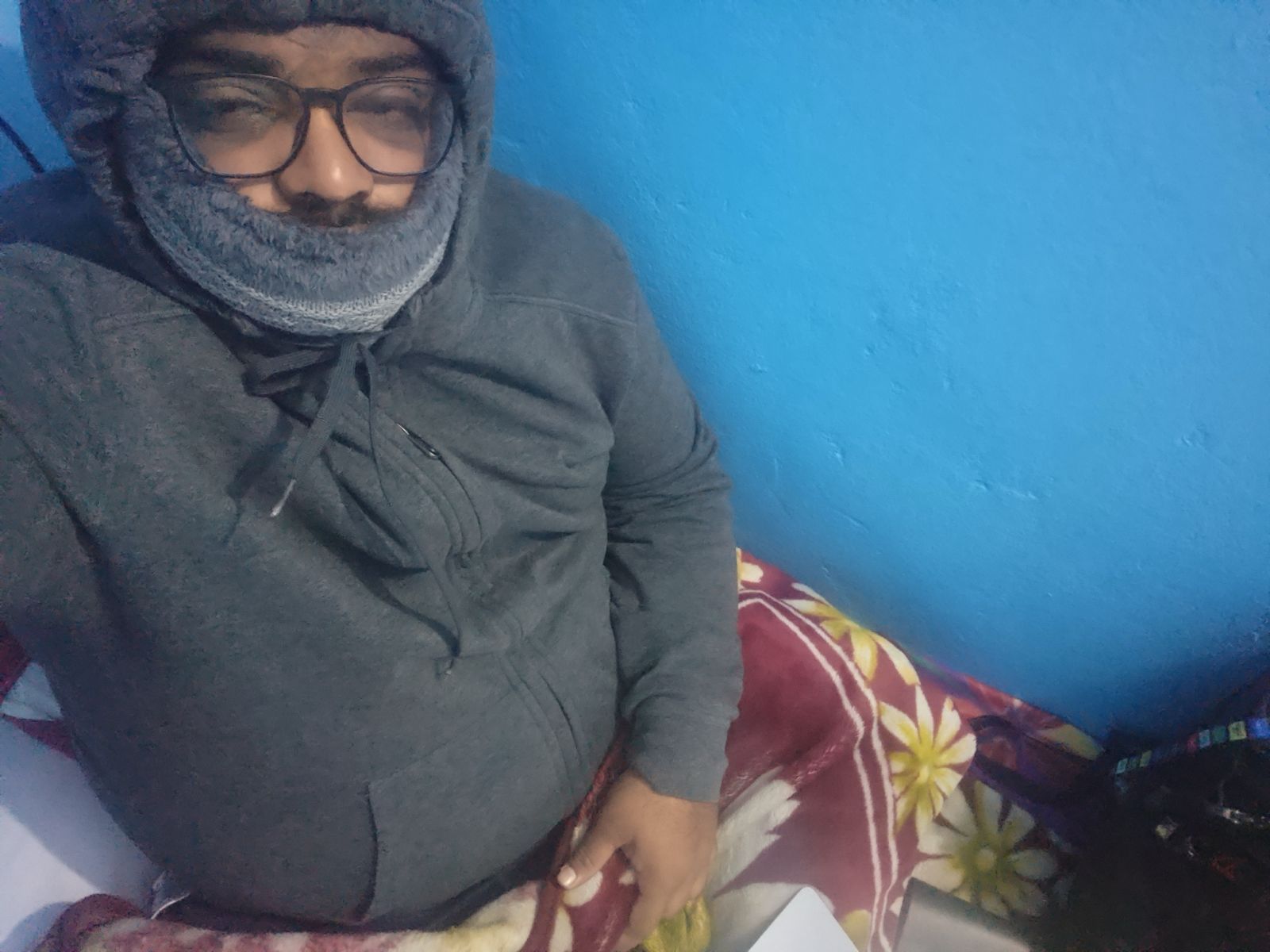
Since it was the beginning of winter, the temperature had started dipping. “One day, the temperature dipped to minus. I wore all the clothes that I had and still I was shivering (top left). Mrs Vidhan went to the market and bought a heater for me. Mr Vidhan came at midnight to check on me and gave me extra blankets,” recalls Saurabh.
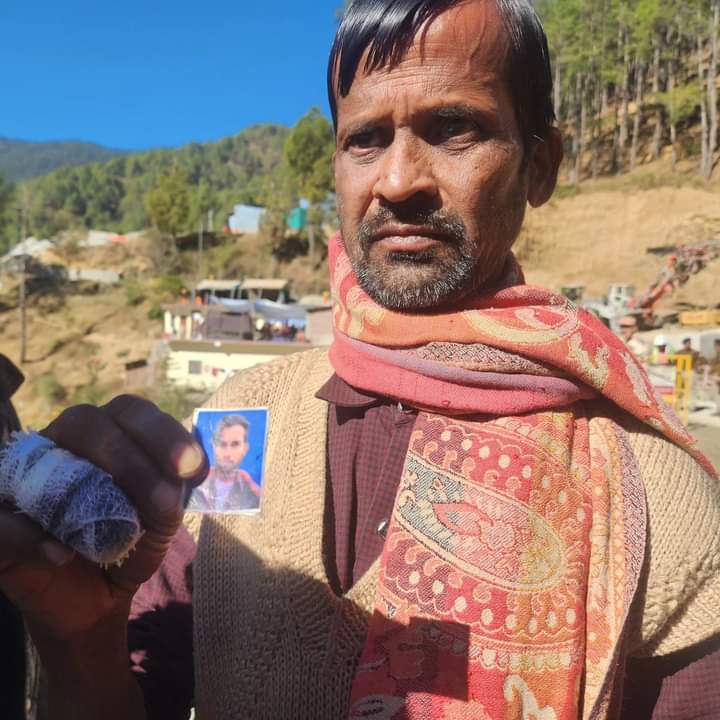
It was because of the kind gesture of the family and all the help they provided, Saurabh had the mental bandwidth to focus on the rescue operations that were going on in full swing. All sorts of equipment, like JCBs and Auger machines, were deployed, but it was proving to be extremely challenging because the debris would reclaim at the spot where digging was being done to save the 41 construction workers who mostly hailed from Jharkhand, Bihar and Uttar Pradesh. Their anxious family members, too, had started arriving in Silkyara and were staying at the makeshift labour camp. It was there that he met Chaudhary ji whose son Manjeet was trapped inside the collapsed tunnel.
“He hailed from Lakhimpur Kheri (in Uttar Pradesh). He had to mortgage his wife’s jewellery to come to Silkyara. He had Rs 9,000 on him when he arrived. The rescue went on for a few days, and because of the extreme weather conditions, some of the family members decided to go back. They didn’t have enough money, so Chaudhary ji helped some of them. In the end, he was left with Rs 254,” says Saurabh.
On November 21, nine days after the tunnel collapse, officials managed to insert an endoscopic flexi camera inside the collapse site. It was the first time that live images of the trapped workers came alive. But Chaudhary ji could not spot his son Manjeet. He called home. Some people were from the village, who were following the rescue story on their mobile amid shaky network, informed him that they had seen Manjeet. “He was very happy The way his moist eyes lit up, it was the most touching moment for me,” says Saurabh.
Chaudhary ji showing a photo of his son Manjeet
Finally, after 17 days, Operation Zindagi ended. What machines could not achieve was accomplished by manual diggers, who diligently, for hours, dug through the tunnel manually by adopting rat-hole mining techniques, and rescued all the 41 workers. They were kept in isolation for 24 hours and were later admitted to AIIMS in Rishikesh. The workers and family members found themselves surrounded by journalists who were there for interesting quotes and bytes. “I managed to talk to a few, but realised they should be left alone. They should be allowed to spend with their families,” says Saurabh.
After the rescue, the story was no longer on the front pages or on prime-time slots. Everyone moved on to the next big story. An exhausted Saurabh returned to Lucknow after all the workers, their families and the journalists left from Uttarakhand. When things settled a bit, he realised it wasn’t just a story; it was an experience of a lifetime. “The kindness showered on me by rake strangers is something that I will never forget. I am still in touch with the Vidhan family, and all others who helped me,” says Saurabh.
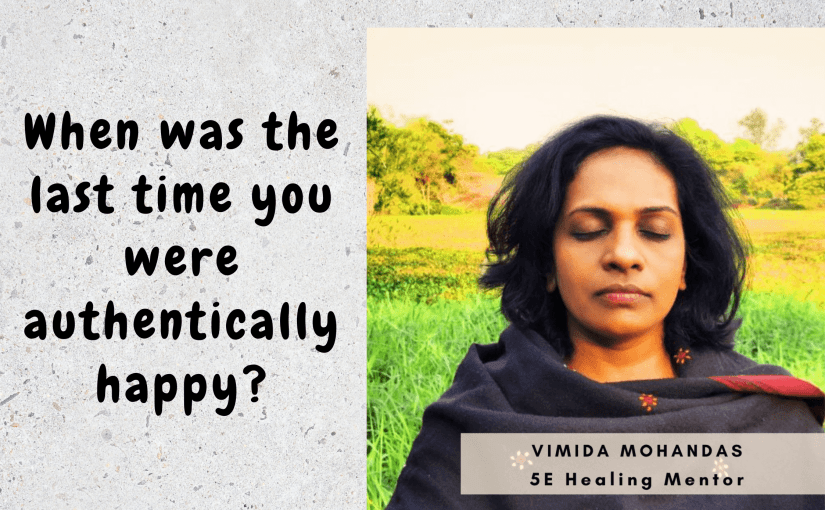
Amidst the chaos and busyness of our lives, we often yearn for a profound sense of peace, clarity, and purpose. It is within this quest for answers that we embark on a remarkable journey of self-discovery. I am Vimida M Das. My insatiable curiosity and love for stories led me to unravel the profound wisdom of the esoteric. I am happy to share my journey with you
…..
My path has been marked by trials that pushed me to the brink. Relationship issues, divorce, health setbacks, and financial struggles left me shattered and consumed by depression, anxiety, and self-doubt. And as if the weight of the world wasn’t enough, I also experienced the devastating loss of my beloved mother.
Grief enveloped me, casting a dark cloud over my existence. In my search for solace and understanding, I delved into countless therapies, sought guidance from gurus, and immersed myself in books, videos, and teachings. However, the answers I sought remained elusive, buried beneath layers of pain.
It was during this tumultuous period that a powerful realisation took hold—the key to my healing lay within. Amidst my sorrow, I began to peel back the layers of my own being, exploring my thoughts, emotions, and deepest beliefs. Each experience became an opportunity for growth as I delved into the depths of my own soul, seeking wisdom and lessons in every trial life threw my way. It was through these moments of introspection that I discovered the transformative power residing within myself, leading me on a path towards healing and personal empowerment.
Today, I carry the memories of my mother as a memento of love and inspiration. I share my journey with others, reminding them that within each of us lies the capacity to heal, to rise above adversity, and to embrace the extraordinary power of consciousness.
“What I Learnt Today”
As the American journalist Bill Vaughan once wrote, “We learn something every day, and lots of times it’s that what we learned the day before was wrong.”
From my personal awakening, I birthed “What I Learnt Today”, a platform that pays homage to the everyday lessons we encounter. With each passing day, I realised the transformative power of continuous growth and the ability to learn something new. I recognised that the knowledge gained from these experiences could be shared to inspire others on their own paths of self-discovery and empowerment.
Recognising the merits of “What I Learnt Today,” my sisters joined me, bringing their unique skills and perspectives to add depth and richness to the programme. The bond of sisterhood infused the bootcamp with an extra layer of support and understanding, creating a nurturing space for participants to heal and grow.
The Five Elements as a Path to Empowerment
At the heart of the teachings of “What I Learnt Today” lie the Five Elements—earth, water, fire, wind, and space—each possessing unique qualities waiting to be harnessed. I strongly believe that by resonating with these elemental energies, individuals can tap into their true selves.
Within the framework of the five elements, each element possesses its own distinct qualities and symbolism.
Earth represents stability, grounding, and nurturing energy. It provides a firm foundation upon which all things are built, fostering a sense of security and solidity. Like fertile soil supporting the growth of plants, Earth encourages us to establish a strong base for our endeavours and cultivate a deep connection with the physical world.
Water embodies fluidity, adaptability, and emotional intelligence. It symbolises the ebb and flow of life, reminding us of the need to navigate our emotions with grace and resilience. Water teaches us the importance of finding balance, flowing around obstacles, and embracing change as an inherent part of our existence.
Fire represents transformation, passion, and vitality. It is the spark that ignites our inner desires and propels us forward on our personal journeys. Fire’s energy is both creative and destructive, reminding us of our power to reinvent ourselves and rise from the ashes. It encourages us to embrace our passions, express our authentic selves, and bask in the warmth and light within.
Wind, or air, embodies communication, intellect, and playfulness. Like a gentle breeze, it invites us to be open, adaptable, and light-hearted in our approach to life. Wind symbolises the power of communication, the exchange of ideas, and the freedom to express ourselves. It encourages us to embrace a light-hearted and spontaneous attitude, finding joy in the present moment and the simple pleasures of life.
Space represents expansiveness, interconnectedness, and limitless potential. It is the canvas upon which life unfolds, providing the space for growth, exploration, and connection. Space symbolises the interconnectedness of all things, reminding us of our place in the grand tapestry of existence. It encourages us to expand our awareness, embrace unity, and tap into our infinite potential.
Together, these five elements form a holistic system that offers insights into the nature of existence and our relationship with the world around us. By understanding and embodying the qualities of each element, we can find balance, harmony, and empowerment on our individual paths of self-discovery and personal growth.
Techniques such as meditation, mandala art, SATS visualisation, and affirmation became powerful tools for accessing and embodying the qualities of the five elements.
The Five Element Healing Bootcamp
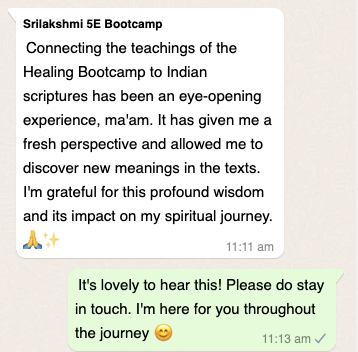
Driven by the desire to share the transformative power of the five elements, the Five Element Healing Bootcamp was born. This immersive programme takes participants on a profound route of healing and self-discovery. Through a carefully-crafted curriculum, individuals learn to harness the energies of the elements, heal emotional wounds, and embrace their innate strength. The bootcamp blends theory with experiential exercises, providing a holistic approach to empowerment.
The first bootcamp was held from May 5-7, 2023.One remarkable story that I would like to share involves a student who had long bottled up her emotions, unable to express even the smallest desires. Through the healing practices of water mandalas, fire ceremonies for letting go, and wind exercises to find joy, this student experienced liberation and an overflow of joy. Shehad unlocked the door to emotional freedom and self-expression.
Vision and Impact
My vision extends beyond my own transformation. My true passion lies in witnessing the sheer joy of individuals who embrace the Five Element Healing Bootcamp. Through this empowering journey, participants shed their burdens, find renewed confidence, and greet each day with a genuine smile.
I hope that in a world filled with uncertainty and challenges, my Five Element Healing Bootcamp will bring hope and empowerment. It will create a ripple effect of positivity in the lives of others and in the world. By embracing the characteristics of the elements within us, we unlock our hidden potential and reach our true calling, enabling us to face life’s challenges with confidence and excitement.
To learn more about the Five Element Healing Bootcamp and embark on your own transformative journey, click here.
Vimida Das is a Coimbatore-based, award-winning creative director and writer. This is a sponsored post. If you want to tell your story, write to us at contactgoodstories@gmail.com
Gaurav Girija Shukla lives in a small town named Arang, 40 kms from Chhattisgarh’s capital Raipur. Nearly 20 years back, his parents opened a school in Arang. Over the years, the school has been providing affordable and quality education to underprivileged children living in nearby villages. The parents of these children belong to lower-middle income groups, Scheduled Castes, Scheduled Tribes, or are farmers and daily wagers. The founders even managed to open two additional branches in far-flung villages. And then came the prolonged pandemic. As of today, the small branches have shut, and the main branch is at the mercy of the personal savings of the founders. Hearts of hearts, they know it’s time to pack up. Shuklas are not alone. There are a little over four lakh low-cost private schools in the country. Due to the ongoing pandemic, tens of thousands of these budget schools have either shut or are on the verge of shutting. For schools in villages or small towns, the demise was slow and painful. In this first-person account, Shukla uses his school as a case study to give us a larger perspective.
Gaurav Girija Shukla
Case study 1
Kajal Chandrakar is presently studying in Class 8. Her family has always struggled to make ends meet. Her father is an alcoholic who often abuses his wife as well as Kajal and her younger brother Kundan. He creates a scene every time his wife spends money on books and notebooks. Kajal is a bright and enthusiastic student. She has to commute for an hour and change two buses to reach school, but she never complained.
Our school shut in 2020 after a nationwide lockdown was imposed. Kajal had to spend 24 hours in that toxic environment. In the absence of proper digital equipment, her education suffered. When the school reopened for a few days just before the second covid wave hit in 2021, she was very happy. However, we noticed that there was a significant dip in her grasping abilities. These children, whose parents are not educated, often gain from peer learning. Because of the long absence from the classroom, her enthusiasm level has gone down.
Case study 2
We had a teacher in our school named Gulshan Chandrakar. After completing his Engineering, he could not find a job. The financial condition of his family was not very stable, and he had old parents to look after. So, he accepted a job as a teacher at our school. Though he was not a trained teacher, he was good with children and taught them math in a very simple manner. Sincere and dedicated, he was with us for five years. Owing to many factors, which I shall write about in this story, we struggled to give salaries to our teachers regularly during the prolonged pandemic. He had no option but to move on and today he is working at a medical store.
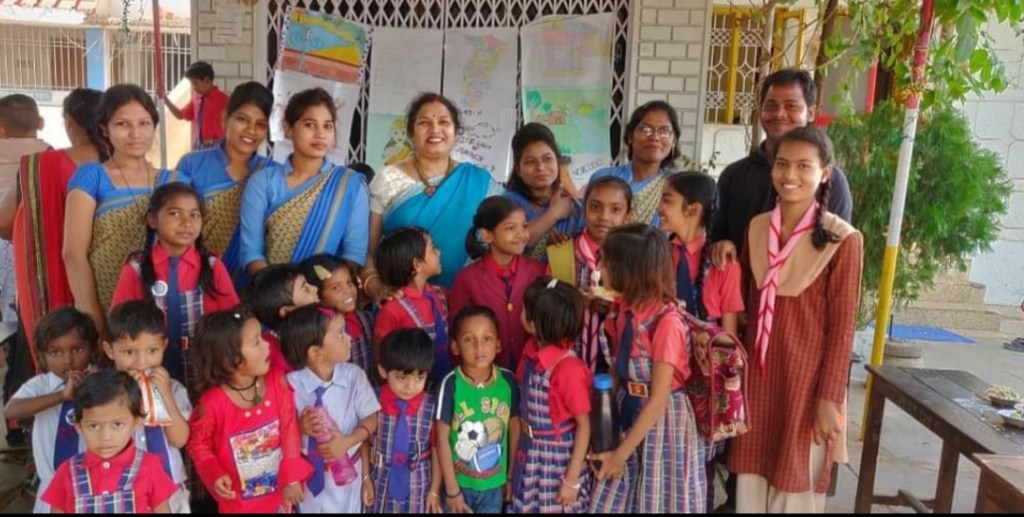
For years, the school has been providing affordable and quality education to underprivileged children
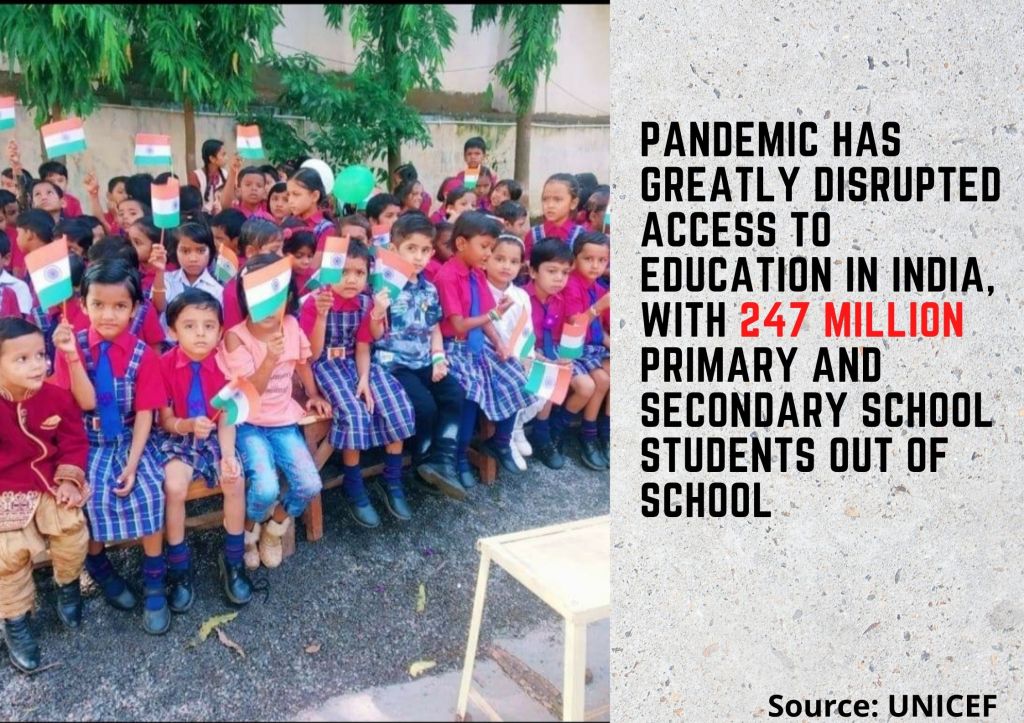
While the above-mentioned case studies are from the school run by our family-owned non-profit Abhikalp Foundation at Arang, nearly 40 kms from Chhattisgarh’s capital Raipur, you will get to hear thousands of such stories from across India. The pandemic has managed to shake the foundations of our education system and the primary victims have been the budget or low-cost private schools (LCPS).
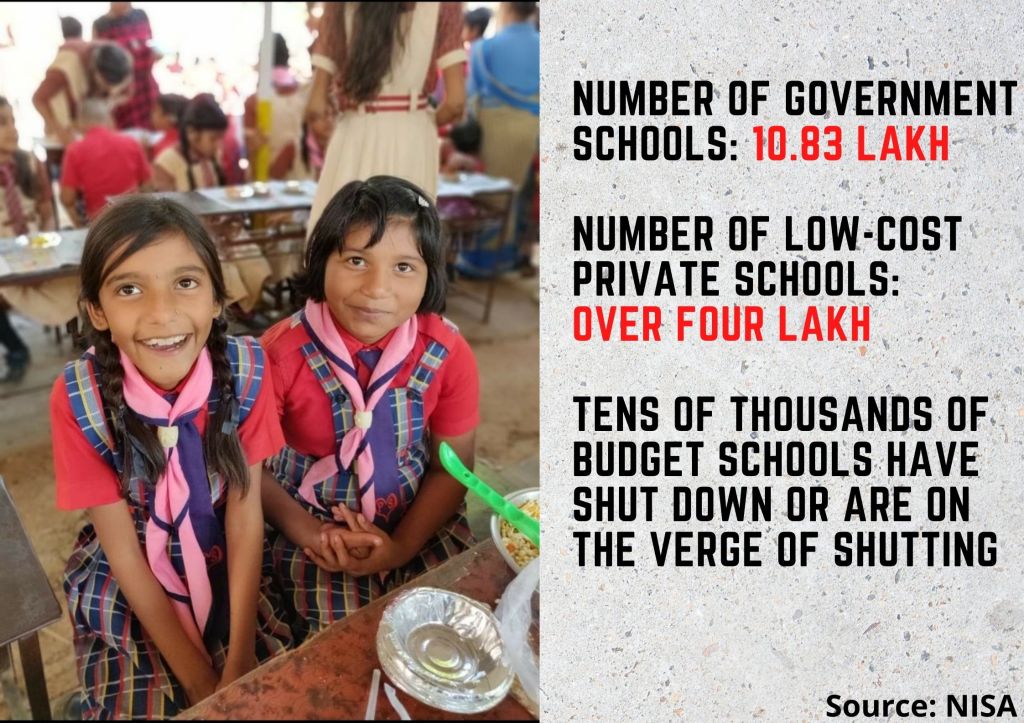
As per the National Independent School Alliance (NISA), there are over four lakh low-cost private schools in India spread across metros, Tier I and Tier II cities, districts, towns, and villages.
Besides, under the Right to Education Act, the government provides free and compulsory elementary education (Class I to 8) to all children. In 2020, there were 10.83 lakh government schools in the country. Parents who are not satisfied with the quality of education at these government schools, often enroll their children in budget or low-cost private schools. In small towns and villages, parents of children studying in such schools fall into the lower-middle class category. They mostly are farmers, daily wage earners, or those who do odd jobs for survival. For most, incomes are cyclic.
While it’s extremely satisfying to provide quality and affordable education to these underprivileged children, running these schools is challenging even under normal circumstances. The pandemic has dealt a massive blow and tens of thousands of such budget schools are on the verge of shutting down permanently. While one can never be prepared for an unprecedented and sudden event like a global pandemic, could we have done something differently to avoid the complete closure of so many low-cost private schools? Can we do something now?
I am not an expert in the field of education, so I won’t be able to comment on what the government should or should not have done. All I know is, for two decades, starting from 2003 until now, my parents – Girija Shukla and Dhruv Kumar Shukla — and I have put in all our efforts so that underprivileged children living in and around Arang could get quality education. This school caters to 30 villages nearby, and, for most children, this school is the only option. Our dream has crashed.
The school won’t survive for one more year unless some miracle happens. On most days, the dinner table conversations are about winding up and moving on. With an emotional heart, I urge you to read this piece. After all, it’s not just about our school. There are thousands of budget schools that have shut or will eventually shut.
Before the pandemic, the school strength was 400. Today, less than 200 students are enrolled
The collapse in a chronological order …
Lockdown confusion
The timing of the 2020 lockdown, which was announced in March, dealt a blow to us. Parents of most children studying in our school are not in a position to pay school fees (Rs 6,000-12,000 annually, excluding transport) at the start of the session or on a regular basis. We don’t insist. Most pay the fees at the end of the session before the final exams. Because of the lockdown, the exams could not take place and the school had to be shut down. So, parents could not pay the school fees. That was the beginning of the end.
In 2021, again, the timing of the second wave and the subsequent lockdown (March-April) coincided with the end of our session. Due to the second lockdown and the closure of the school, again, parents chose not to pay the fees. So, technically, we have not been able to collect 100% school fees from the 2019 session onwards.
It was a tricky situation. We could not pressurize or urge the parents to pay the fees as most of them had lost their jobs during the lockdowns or could not earn. So, though many of them chose not to pay the school fees due to the financial crunch, there was nothing we could do to make them pay.
Imagine our plight when the third wave hit in the beginning of 2022. We are nearing the end of yet another session and the schools have just reopened. For us, there is a lot of anxiety regarding school fees which takes care of a chunk of our expenses.
The digital divide
Here’s a harsh reality. In the Adivasi belt that we are functioning in, there are people who, with great difficulty, manage to buy one basic mobile. Smartphones are a luxury item. Families with two smartphones are almost non-existent. Parents of most of the students studying in our schools have one smartphone, the purpose of which is to send messages and make calls. Because of severe network issues, these smartphones are not used extensively. Most parents are not educated. They were not in a position to help children with online classes or help them with their homework. There was no one to help them resolve the technology and network-related issues.
Similarly, teachers in our school are not trained teachers. They don’t come from very affluent families, so they are in possession of basic gadgets. It was a struggle for them too to learn tasks like conducting classes on Zoom or Team Meet, sharing screens, uploading, and downloading documents or giving assignments and correcting homework online. It was next to impossible to teach all these things to children sitting in far-flung villages. Poor network was our biggest roadblock.
When they somehow managed to get hold of these things, the administration decided to allow teachers to come to school and conduct online classes. That posed newer challenges. When nothing seemed to be working, we even hired a few volunteers who taught different subjects to children, but it was, at best, a temporary solution.
Confusion regarding school fees
In April 2020, Bhupesh Baghel, the chief minister of Chhattisgarh, tweeted saying: “Many private schools are sending messages to students’ parents to deposit school fees. It is not appropriate to pressurize them for fees at such times. All schools have been instructed to postpone the recovery of fees during coronavirus lockdown in Chhattisgarh.”
After many small-scale schools reached out to the administration complaining that the school fee is their only means to pay the salaries of the teachers, the High Court, in July 2020, said the schools were allowed to collect only the tuition fees.
The financially stable private school welcomed the decision, but parents of children studying in schools like ours were not happy. They were of the view that since the school was not functioning and the online classes were proving to be too chaotic wherein children were not learning properly, they should be exempted from paying any fees at all. Even after reducing the fees to half, we could not convince them to pay up. In such a situation, we could not pay our teachers regularly.
Because of the fund crunch, our investments started taking a hit. Let me give you an example. Just before the lockdown, we had bought two school buses for the convenience of children living in faraway villages. That was a very big investment worth lakhs of rupees. We have hardly used the buses, but to date, we are paying the EMIs. The buses are just parked in the compound for the past two years, and that’s pinching us financially. Now we are using our personal savings to pay the EMIs. I know many instances wherein school buses owned by low-cost private schools have been seized by the finance companies because of their inability to pay up.
Students switching to government schools
Because the parents were not willing to or were not in a position to pay school fees, many of them withdrew the admission of their children from budget schools and enrolled them in government schools where there was no obligation to pay any fees. This rampant switch happened because for these parents who are not educated, educating their children is not a high priority, especially when there is a severe financial crunch and arranging for even two meals a day is a task.
As per the Annual Status of Education Report (ASER), 2021, which assessed enrolment patterns, tuition trends and smartphone access of children in rural areas, the government school enrolments had risen from 64.3% in 2018 to 70.3% in 2021. The corresponding decline in private school enrolments has been from 32.5% in 2018 to 24.4% in 2021. In Chhattisgarh, in the 6-14 age group, enrolment in government schools increased from 76.4% in 2018 to 82.9% in 2021.
In our school, before the lockdown, 400 students were enrolled. Today there are less than 200. The students who moved out had been with us from the beginning. We had invested our time, energy, and efforts in them. It was heartbreaking.
Confusion regarding transfer certificates
The shift from low-cost private schools to government schools began in 2020 itself and parents started approaching the schools to get transfer certificates. After some budget schools refused to hand over the transfer certificate saying the parents had to clear the dues first, the state administration intervened.
Soon after, the School Education Department sent a letter to all District Collectors and District Education Officers and urged them to ensure admission of all students leaving private schools. The letter mentioned that during the time of admission of these students, their transfer certificate or earlier class mark sheet should not be demanded. Now, the parents were not under any obligation to clear the dues before cancelling the admission. These flip-flops from the parents and the administration further complicated the situation for us.
Now, either the schools are shut, or half the students have moved out
Just after the second covid wave in 2021, at least 500 private budget schools in Chhattisgarh shut down. Most of these private schools were running in rented buildings and they had to wind up due to their inability to pay the rent. The school managers informed the education department of the state about the closure of their schools. Due to this, the future of about one lakh students who were studying in these schools, was in limbo.
It was unfortunate, but the schools that were running in rented buildings were not as unfortunate as us. Winding up was not difficult for them. In case we have to shut down, what will happen to the school buildings? The school buses? There is a playground and a small computer lab. What do we do with all this? The government guidelines say schools will have to follow proper covid protocols after the schools reopen. We don’t have the money to give salaries. How do we sanitize the whole building periodically?
Hence, at this stage, we don’t know if it makes sense to keep the school running for one more year, with half the student strength and teachers who have lost the enthusiasm and motivation.
Plight of children studying under the Right to Education Act
In Chhattisgarh, as many as 60 lakh students are enrolled in 57,000 private and government schools combined in an academic session. Around 15 lakh students are enrolled in 6,615 private schools of which 31,317 students are studying free of cost under RTE on 25% of the seats. Because of the closure of the private schools in such a large number, about 20,000 students who were studying free of cost in these schools under the RTE Act have also been deprived of free education.
In my school, most of the students who are still enrolled are RTE students. Briefly, the central government releases funds to the state government, the state government releases funds to the schools and that’s how the fee of these children gets paid. It’s a long-winding process. However, there has been a delay in the release of funds from the central government. It’s a double whammy. And, in case, if we have to shut our school, I have no idea what will happen to these children studying under the RTE.
No help from the government, no policy changes
India’s education sector has received a 11% hike in the 2022 Union Budget this year. Many interesting schemes have been rolled out. However, school managers like us, who were looking for specific measures to bring the education system back on track, are disappointed. We have many questions. Like, will individual schools get financial help? What happens to low-cost private schools? How do we sustain ourselves post pandemic? What about the students who have moved to government schools? Do these schools have the infrastructure to educate so many students? What if there is a fourth wave, and a fifth? What happens to the existing infrastructure if I have to shut down my school? Will I get some waiver on the school buses that have costed me lakhs? Lastly, what was the fault of these children and teachers? How do our schools survive post-pandemic?
Gaurav Girija Shukla is based in Raipur, Chhattisgarh. He is the owner of Sangyaa PR and Abhikalp Foundation, which runs the school in Arang.
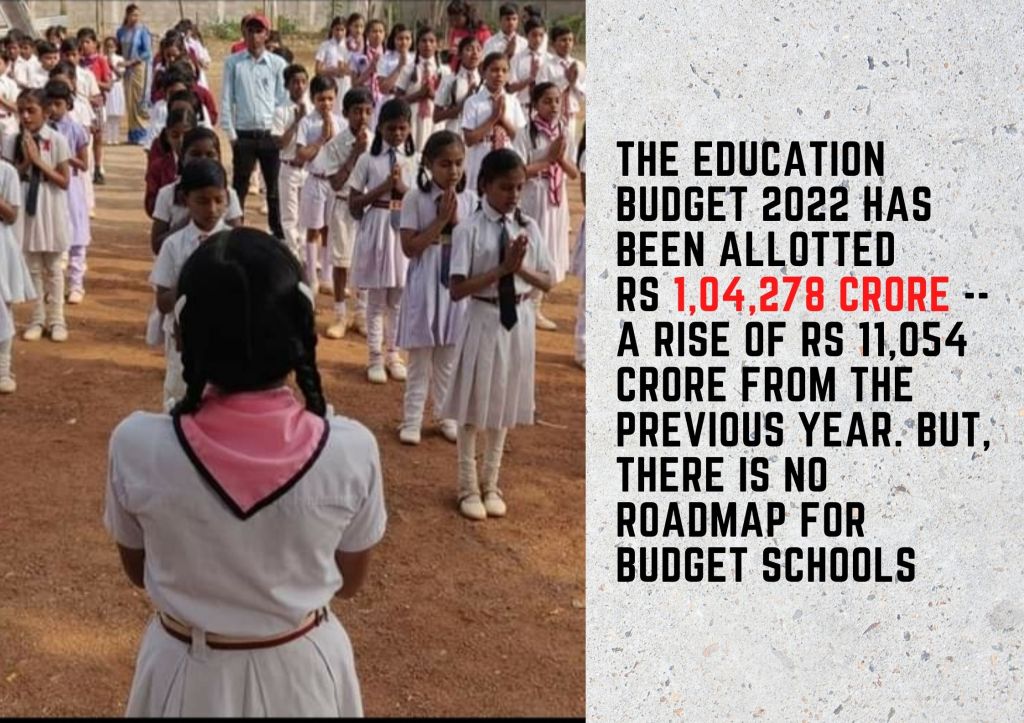
This story is a joint effort between Shukla and The Good Story Project’s Swati Subhedar. While Shukla provided case studies, story material, and images, The Good Story Project was responsible for conceptualizing, writing, and structuring the story. Please note that images used in the graphics have been sourced from Abhikalp Foundation and have been used for representation purposes only. They have nothing to do with the data being provided in the graphics.
We do hope that you enjoy reading our stories. We are a very small team of two; with no funding or resources to back us, and your contributions will help us in keeping this platform free and accessible for everyone. If you wish to contribute, click here.
As per the United Nations, there are over 476 million indigenous peoples living in 90 countries across the world, accounting for 6.2% of the global population. They are the holders of a vast diversity of unique cultures, traditions, languages, and knowledge systems. On this International Day of Indigenous Peoples, Dr Deepak Acharya, an Ethnobotanist, a PhD in Plant Sciences and a herbal enthusiast, who has been working with Adivasis for many years, takes us to the jungles of Dang in Gujarat, Patalkot in Madhya Pradesh, and Bastar in Chhattisgarh to introduce us to some of the ‘superfoods’ that the Adivasis living in these regions consume; some of which can and should make a way into our kitchens! A first-person account …
….
I have been visiting the Patalkot Valley in Madhya Pradesh for the past 20-25 years. The breathtaking and mystical valley, situated 78 kms from the Chhindwara district in Madhya Pradesh, has been my second home for years now. The valley, spread over an area of nearly 80 square kilometers, is known for retaining its original culture and customs and is home to the Gonds and Bharia tribes, who, experts claim, have been living there for the past 500 years.
The Patalkot Valley is the home of some of the rare medicinal plants and herbs and the Adivasis living in Patalkot make pulps and extracts of these herbs and plants to treat many illnesses and diseases, including measles, cholera, hypertension, diabetes, cough, snake bites, and many aches and pains.
Over the years, the Adivasis living in the 12-13 hamlets in Patalkot have not only become my family and friends, but they have also imparted their wealth of traditional knowledge onto me. These are their secret formulae that you will not find in any academic books. One gets to learn so much just by observing them and interacting with them.
For instance, in the initial years, when I used to visit Patalkot, it was astonishing for me to see how even the elderly, the women and the children would walk for 15-20 kms daily without getting exhausted. I would feel ashamed as even a kilometer-long hike would make me breathless, and they all would stare at me as if I had committed some crime! Then, gradually, valuable tips shared by them helped me work on my stamina and strengthen my lung capacity. I started documenting the stories narrated by them and that’s how I discovered a superfood — their secret recipe to physical fitness!
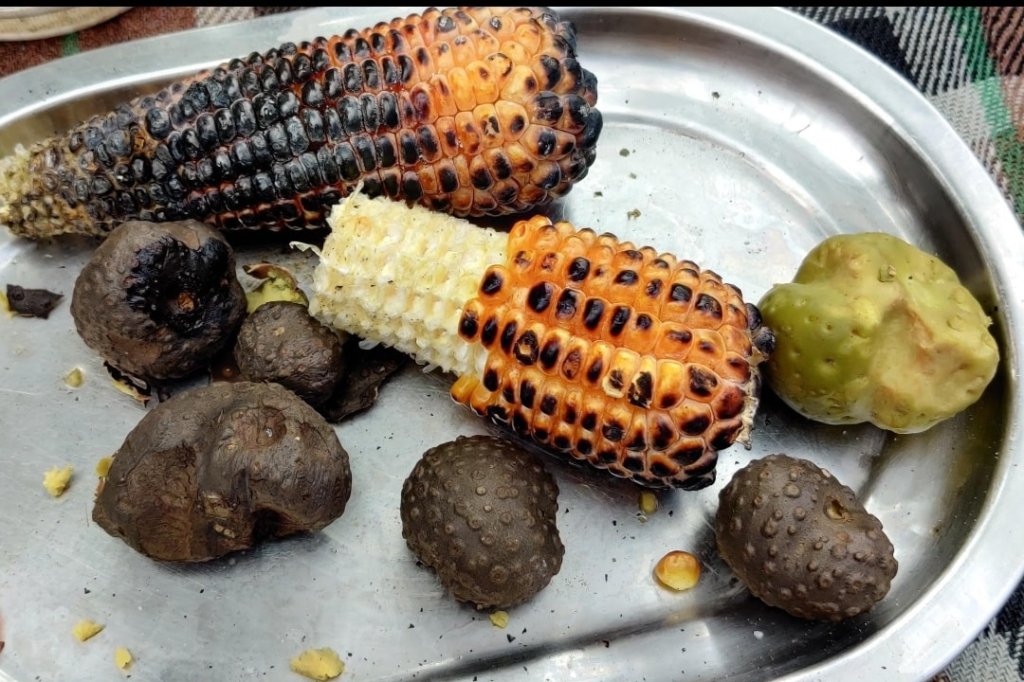
These Adivasis consume a root vegetable called agitha (known as Air Yam or Air Potato in English). Full of potassium and manganese, proteins, minerals and macro and micro- nutrients, these agithas give them the requisite strength to survive in difficult terrains by making their heart stronger. It also improves their digestive system.
Now, this is what is incredible. Adivasi women recommend agitha to treat vaginal dryness and hot flashes. It is also eaten extensively by women who have hit menopause. Initially, when I learned about agitha, I wanted to crosscheck the claims made by the Adivasis with the facts existing in scientific journals. It is well documented that agitha contains an element called Diosgenin which has diverse medicinal properties, including antioxidation and anti-inflammation. In fact, a review article mentioned that Adivasis living in Africa make pulp of agithas and use it to treat vaginal infections, irregular periods, and other inflammations. However, there is no study that elaborates on the connection between African Adivasis and Patalkot Adivasis! I have no idea whether, back in the day, the Adivasis from Africa visited Patalkot or the Adivasis from Patalkot went on an African safari! But it’s incredible how this knowledge gets passed on from one generation to the other and transcends geographical boundaries!
Agithas, that taste like boiled potatoes, are often eaten with salt and rotis. Image credit: Deepak Acharya
If you visit Patalkot or other such Adivasi-dominated regions, you will find these Air Yams carelessly hanging on to the fences of their homes. One crop fetches 10-12 kgs agithas in one season. This goes on year after year. Interestingly, one big root that produces these small agithas keeps growing beneath the surface of the ground. It’s taken out once in 2-3 years and weighs between 6 and 12 kgs. This is also boiled and consumed, however, once this root is uprooted, a new crop of agitha has to be planted.
Once, when I visited the Dang district in Gujarat, also an Adivasi-dominated region, I was ecstatic when I was served agitha with a roti made of rice flour! The agitha-roti combination was the best meal I had had in days!
Agithas taste like boiled potatoes. If these agithas find their ways into our kitchens and are given to women and children, imagine how fit and healthy the next generation is going to be! Unfortunately, we have been bitten by the consumerism bug, and most of us often end up picking up such ‘traditional superfoods’ from supermarkets and end up paying a bomb for these products in the name of healthy living. Instead of popping health capsules and multivitamins, we must create awareness among people so that they start consuming these traditional healthy superfoods; treasures that Adivasis and those living in remote corners of the country have preserved for years.
I am glad my work has taken me to places and I was able to document some of these incredible stories.
The Madia crabs. Image credit: Ravish Raj Parmar
Crabs and mushrooms to beat monsoon illnesses
As soon as the monsoons arrive, the Adivasis living in the Bastar region of Chhattisgarh flock to the nearby rivers, ponds and lakes to catch crabs. Seen in the picture above are the Madia crabs, which are said to be packed with healthy minerals. The Adivasis living in Bastar either make crab soup or eat a roasted delicacy. They believe the Madia variety of crabs boosts their immunity, keeps them warm during the brutal monsoon, and makes their bodies stronger. If you visit the markets in Bastar during the monsoons, you will find many Adivasis selling these crabs as they are also a source of their income. These crabs are also eaten in Dang, Gujarat and Patalkot, Madhya Pradesh.
Another common monsoon delicacy for the Adivasis are the mushrooms. Seen in the picture below are the Boda mushrooms that are predominantly found in the Bastar region. A fun fact. The Boda mushrooms are one of the most expensive vegetables sold in India! A kilo of Boda mushrooms easily fetch Rs 1,000-1,500 or more! And the reason for this is that they are packed with medicinal properties and essential nutrients and minerals. The Boda mushrooms are full of carbohydrates, fibers, zinc and, iron and are used to treat heart and blood pressure-related diseases. There are two varieties of Boda mushroom found in Bastar — Jaat Boda and Lakhri Boda, but it’s the Jaat Boda Mushroom that’s more famous and lucrative.
The Futu and Boda mushrooms. Image credit: Ravish Raj Parmar
Interestingly, these Boda mushrooms are also very elusive. The Adivasis have to do a lot of hard work to find these Mushrooms in the dense forests of Bastar. However, they also have an eye for these mushrooms and they spot them easily.
Another variety of mushrooms that’s commonly consumed by Adivasis to keep monsoon illnesses at bay are the Futu mushrooms that are packed with antioxidants and proteins. Many varieties of Futu mushrooms grow in the jungles of Bastar. Not all are meant to be consumed, but the Adivasis can identify the varieties, like the Jaam Futu, that can be bought home and consumed.
Mahua rotis and raspberries leaves to reduce labour pain
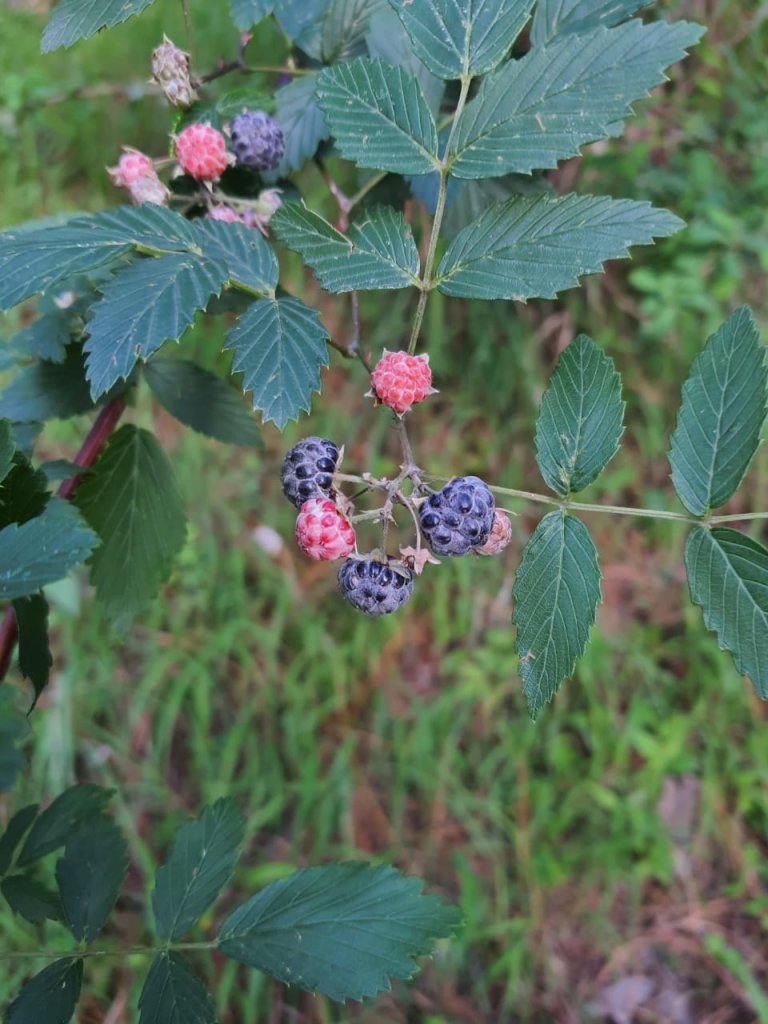
A couple of years back, I visited Shimla to attend a conference organized by the National Biodiversity Board. After the meeting sessions, I would go hiking into the jungles. I would walk for 25-30 kms daily and meet and interact with local people. One day I saw an old lady plucking raspberry leaves. I came to know while interacting with her that these leaves are packed with medicinal properties. Expectant mothers are given these leaves. Consumption of these leaves helps in reducing labour pain. These leaves are also used to treat other stomach aches and stomach-related illnesses. Those living in the interior villages in the Himalayas have been using these remedies. One cup full of raspberries contains 56% vitamin C and 45% manganese and micro-nutrients. Do consume raspberries when you can!
Raspberry leaves are crushed and given to expecting mothers. Image credit: Sangita Thakur
Another delicacy that’s not just a hit with the Adivasis living in the Central belt of the country but is also a lucrative source of income for them is mahua. They make and sell liquor made of mahua, but they also consume chapatis made of dried mahua flowers. Also, the mahua seeds are crushed to make an oil which in local parlance is called ‘gulli ka tel’ (gulli oil). It is used to treat many skin-related infections.
There are many such food stories that Adivasis all over India are ready to share. We must start documenting them for our own good. Some of these superfoods stare at us from the shelves of supermarkets, and many of us end up buying these super-expensive products in the name of health, but in reality, some of these products are present around us. All we have to do is look around and try to make these Adivasi traditions a part of our lives.
Do you know Adivasis use the pulp of raw papaya to remove unwanted hair? Those living down South use coffee powder to exfoliate their scalp? Many Adivasis use dried pomegranate to deal with dental plaque? Deepak Acharya documents such stories regularly on Facebook. To read such interesting stories, follow Deepak Acharya on Facebook.
says Anjali Fahnline,14, as she looks back and writes about her adoption journey. Fahnline and her two sisters were adopted in 2017, and she is our youngest ever contributor, bringing in the much-needed perspective as an adoptee, and an honest account of her experiences and feelings
When I found out that I’m getting adopted to another family, I didn’t understand what they meant. Few days later Amma, who was the head of the hostel, said that my sisters and I were going to meet our new mom. I understood then that I was getting a family. I wasn’t excited to meet my new family, but I just pretended to be because I didn’t want them to think that I was not happy to see them.
One April afternoon, we left to meet our new mom. I was nervous. When we arrived, I saw a woman wearing a beautiful saree. She came towards us and I said, “Hi Ma’am.” She smiled. Then I said “Mom?” She said yes. She introduced herself, “Namaste, I am Rama, your new mom.” She sounded friendly. However, because she was wearing glasses and had short hair, I was afraid that she may be strict. She reminded me of a woman I knew who was very mean to everyone in the first hostel we stayed at.
When we went to a separate room to talk, our new mom asked, “What do you like to do?” I said, “I like to play with the kitchen set.” I used to love to pretend play. It was so much fun to cook, pretend to be a parent and send kids to school. Our new mom got a delicious biscuit which we all shared and talked about other things for a while. She asked us about the things we don’t like, and I replied, “I don’t like it when adults fight.” I don’t think any kid likes it when their parents fight. They get scared and sometimes, it becomes traumatic and haunts them for the rest of their lives.
Sometime later, she showed us her husband’s photo. We were shocked! My sisters and I had never ever seen a white man or woman in our lives and there he was in the picture!
I imagined his whole family looking white, it was like he had put so much powder on his face; that’s what some people do in India. I asked our new mom, “When are we going with you?” I wanted to make sure how much time I had with my friends in the hostel. She answered, “As soon as the paperwork is done.” We had a good time talking and sharing things about our lives. I felt happy because she wanted to know about my life, my likes, and dislikes.
I didn’t feel good about going and living a completely different life and leaving my birth mom. I thought what if she comes to my hostel and looks for us, and we are not there? It was very hard to think of living in a new world. That evening, at the hostel, everybody asked questions: “Are they rich? Are you going to America? Are they nice?” I didn’t answer because I didn’t know if they were rich or if I was going to live in America. America is a big and rich country to live, and I had never even dreamed of living there.
At the same time, there was something that made us happy. My sister and I were excited about getting beautiful dresses, living in a nice neighbourhood, and having things. We had been poor and faced many difficulties. The place we lived was not very safe, my birth dad had been violent, and we were not able to get a good education. I was kind of excited about the new opportunities. But I still wondered if I was ever going to see my birth mother again. So far, I haven’t, but I know I will one day! I was scared too because some people in my hostel frightened us. “They’re your second parents, so they’ll be mean, and will hit you and your sisters.” I’ve heard a lot that second parents don’t treat you like their own kids. I was anxious about our safety.
From what I have experienced, I don’t think all second families are mean. To be honest, I do feel worried about my family getting rid of us or doing bad things to my sisters. Kids who are adopted have that kind of fear inside them. It takes time to trust everybody again and adjust to the new life. It took me and my sisters a lot of time, and I’m still working on trusting everybody again.
After few months, my new mom and dad came to pick us up; we were going to stay with them until the court hearing. It was so hard to leave my hostel. My sister and I cried. Everyone there kept us safe and happy for three years, and now I was leaving them. I gave a speech saying how much I loved them, I was so sad that I couldn’t even say anything properly. I distributed ladoos to everyone and took a final picture. I didn’t want to leave anyone, especially the woman who took special care of me, like a mother. Before I left with my parents, she gave me some of her jewellery, and her photo. I still have them with me.
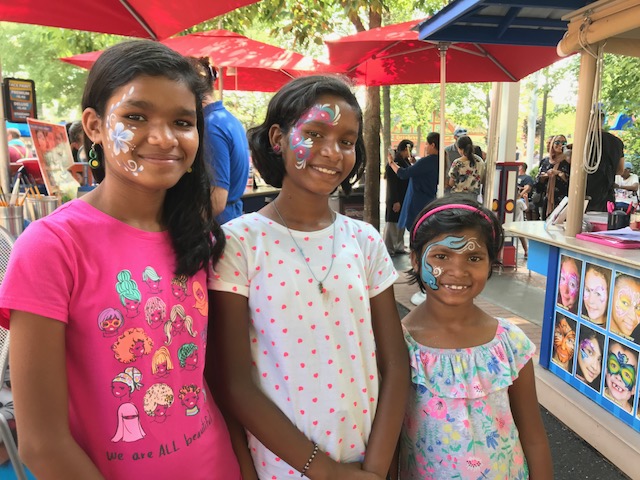
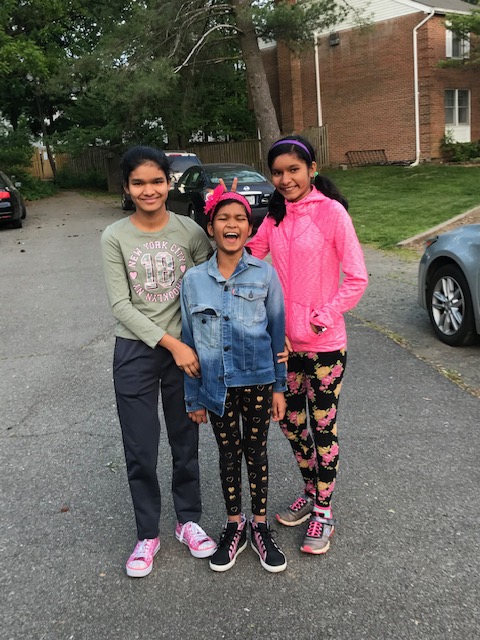
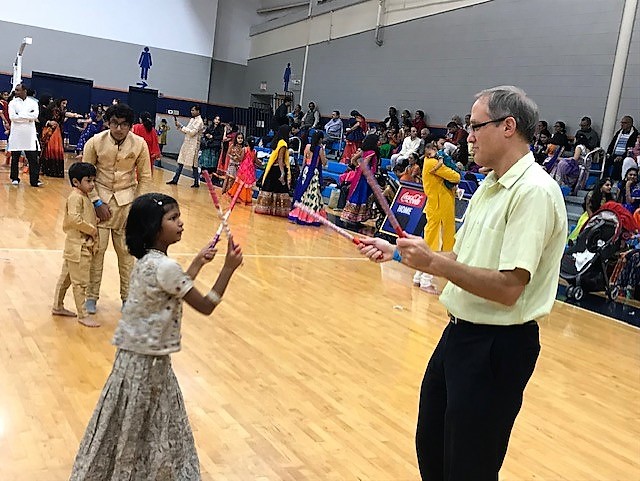
From top left to right: Anjali with her siblings, Anjali and her siblings earning how to drive a bicycle with the help of their father, Anjali’s youngest sister playing garba with their father, and Anjali and her siblings with their mother Rama
It rained heavily as we drove nearly three hours to get to our hotel. My sister and I were so tired that we fell asleep before we went inside the room. My sister wanted to use the toilet, but it was not the Indian style that we were used to. My mom helped her use the bathroom and my sister went back to sleep.
The next morning, my younger sister saw my new mom wearing a short skirt. And she called out to me and said, “Didi (elder sister) look, she’s wearing small skirt, doesn’t she feel shy?” I told her, “Shhh, she will hear you and then she’ll be upset. Be quiet.” But my mom already heard her and said, “It’s ok.” We never saw women wearing anything short. Then we went out for breakfast. There was nothing that we knew or liked except bananas. There were pancakes, waffles, and other things that we had never ever seen, not even in books or on TV! We had bananas and omelette for breakfast, after which we went shopping for clothes. I was so surprised to see such a big store, then I found out that it was called a ‘mall.’ We bought some pretty dresses and night clothes and went back to the hotel.
We stayed in the hotel for few more days, then moved to an apartment in Thane. For my parents, it was hard because the bathroom was Indian and there was no furniture. We had to get a lot of things. We sisters feared the dark, so we kept the lights on the entire night. We all slept in the same room. One day I woke and didn’t see my mother. I started crying, worried about how to take my sisters back to the hostel. She came out – she was in the other room. After that night, my mom left a note beside me even if she went to the bathroom. We watched Hindi movies on the iPad. It was something familiar. Our parents sent us for classes so that we had a routine. People were friendly to us, and we learnt a lot of new things. My mom bought north Indian food from outside because that’s what we always ate. She didn’t cook north Indian food. Her cousin lived a few houses down, and we spent time with them. I learned to use a library, got pocket money, made choices on how to spend it, and ate out at restaurants.
Soon it was time for the court hearing. I asked my mom what will happen at the court hearing. She said, “They will ask you if you want to live with us or go back to the hostel.” I asked, “What if I said no, I want to go back?” She replied, “The judge will listen to your choice. You will go back to the hostel and I will go home.”
I had to make that decision for me and my sisters. I decided that I will say yes. I wanted to live with them because I liked the few days that I spent with them. I felt safe. I was also happy to give them the responsibility of caring for my sisters. I couldn’t accept her the same as my birth mom, but I felt comfortable with my new mom.
When the judge asked me if I was ready to go with my new parents I said “Yes, my sisters and I will go with our new family.”
(Anjali Fahnline enjoys designing clothes and henna, is an avid photographer and is excited to help other children in similar circumstances. You can read more of her writing at Anjali’s corner at www.forallourkids.com)
You may also want to read Sangitha’s piece on adoption.



















 The Good Story Project