Meet single mom Shital Shah and her two adopted daughters

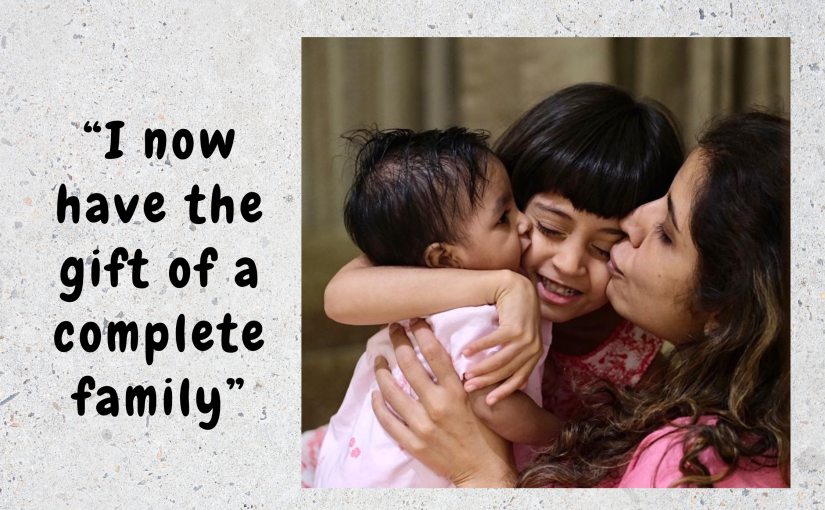
Shital adopted Serena in 2018 and Sara came to her life in 2023. An actress, director and entrepreneur, Shital feels the concept of parenthood in our society is changing now and people are warming up to the idea of having a family based on love and organic connection rather than just birth and DNA

….

Deepika Sahu

Shital Shah, actress, director, and entrepreneur, is relishing her life right now. This 37-year-old single mother can’t stop talking about her younger daughter Sara (nine months old now), whom she adopted in 2023. Earlier, Shital had adopted her older daughter Serena in 2018. Shital is having her time under the sun and enjoying this beautiful phase of her life with her two daughters. 

Talking about her experience, Shital, who has directed Gujarati films like HuTuTu: Aavi Ramat Ni Rutu, Duniyadari and Saatam Atham and acted in Hindi TV shows like Arjun and Bollywood films like My Friend Ganesha, says: “I was always very sure about adopting girls. I feel families are shrinking now. My grandparents had eight siblings, my parents had four and I have a sister. I have experienced the joy of having a sibling. I wanted to give that experience to my daughters. But I must say the process has been very organic. I adopted Serena in 2018 and Sara came to my life in 2023.”

How has been the experience this time? Is it easier for her to navigate now? Shital says: “It’s definitely different now. When I had adopted Serena, I did not have the knowledge about how to manage a two-month-old baby. Right now, I can manage things because I have the experience and that makes a huge difference.” 

She adds: “The adoption process of Sara was much easier and smoother. A lot of credit goes to the Central Adoption Resource Authority (CARA). The whole process is done online. It is the choice of building a family through this agency that really works well.” 
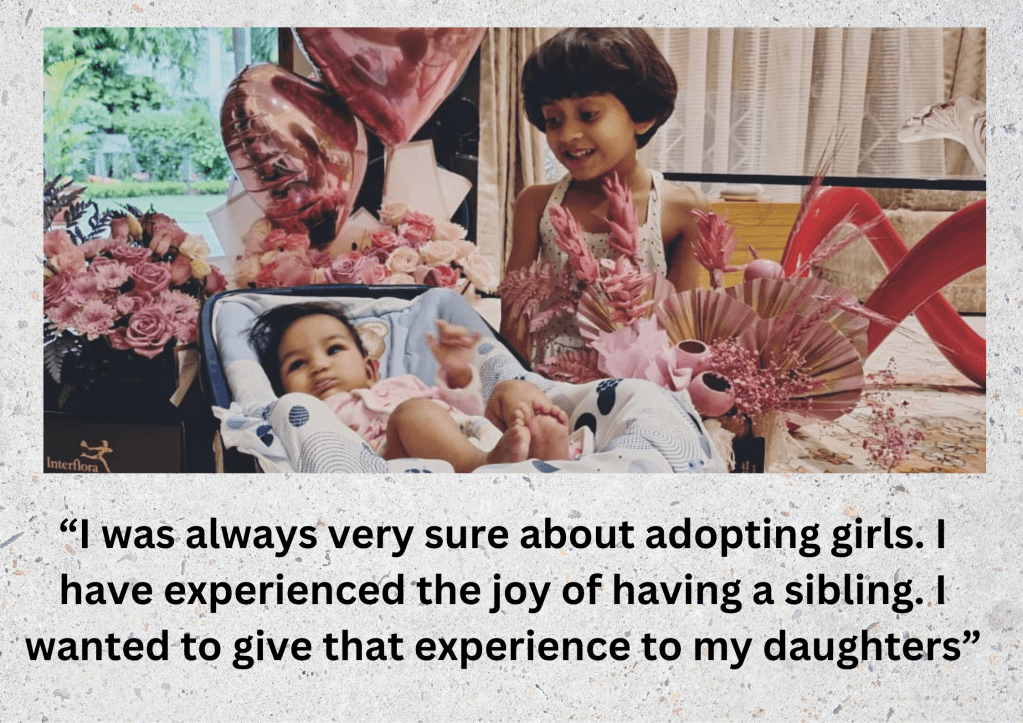
Shital loves being a witness to the sibling bond between her daughters. “Serena is my biggest strength. She takes her role of being a big sister seriously. She is very attentive and loves Sara.” 

Did she ever feel the pressure of doing it as a single woman? Shital shares: “I feel, families are much more than sharing DNA. Adoption is a beautiful way to have a family. In my mind, I never had any links between marriage and having a child. I went ahead with my decision to adopt when I was financially and emotionally ready for it.”

How has motherhood changed her as a person? How does she deal with the changes in her lifestyle too? Shital says: “Last five years have been very fulfilling. Prior to motherhood, I was a single girl and I always took spontaneous decisions to go out. Now, I plan my schedule keeping my daughters’ needs in mind. I really don’t miss going out. I have grown ten years younger just by being with my daughters. I dance at the drop of a hat. I now see many things through the eyes of my daughters. Like before, on many occasions, I did not notice the roses in our garden but now I discover the wonders of the garden with my kids. I have become more aware of myself. Adopting my daughters has changed the goal post of my life.”   

She adds: “I am living more in the present. I used to think a lot about the past and future. My daughters have taught me to live in the moment.”

How hard is it for her to manage as a single mother? “Well, as a single mom, I am 100% responsible for bringing up my children. When you are a couple, bringing up children is a different process. In many households, child rearing is divided between both the husband and wife. That support is invaluable. Yes, it’s true that sometimes I miss that kind of support but I feel this journey is worthwhile. When you are both a primary and secondary care-giver, it can be daunting sometimes. But I am really enjoying this process of growing up with my daughters. My mother Hina Shah and my sister Shaina Shah have always given me rock-solid support.”

She adds: “I am happy that my daughters have chosen me. I firmly believe that I am far more blessed that they have chosen me. When you come from a space of deep love, there’s an element to the purity of connection. When 3.5- month-old Sara looked at me for the first time, she gave me a big toothless grin. And that smile filled my heart with joy and love.” 
How has motherhood helped you to evolve as an artiste? Shital thinks it has. She says: “I have always been a sensitive person. Earlier, when I would hear a child crying and throwing tantrums, I would think what are the parents doing. But now I know. Every child is unique and we can’t put them in one box. That understanding has helped me evolve as an artiste. It has given me a sense of experiencing life in its purest form.” 

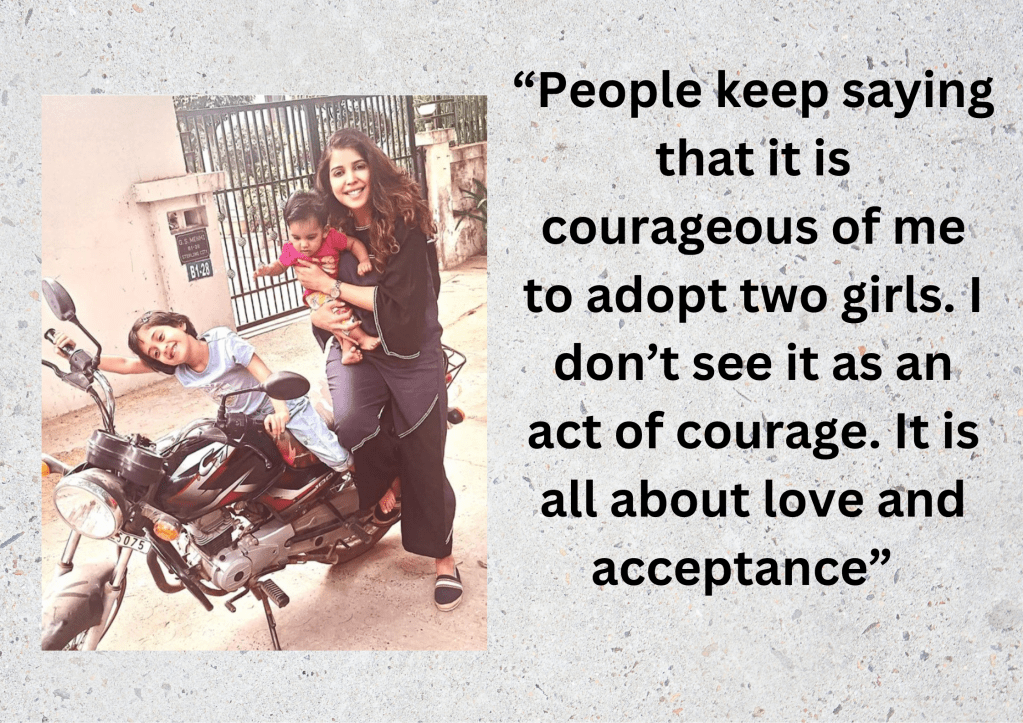
Shital feels the concept of parenthood in our society is changing now and people are warming up to the idea of having a family based on love and organic connection rather than just birth and DNA. “Many of my friends are now exploring the option of adoption. However, still, so many people keep on telling me that it is so courageous of me to adopt two girls. But I don’t see it as an act of courage. It is all about love and acceptance only.”   

Image credit: Shital Shah

Deepika Sahu has been a journalist for 28 years and she has worked with some of India’s leading media houses. Right now, she is independently engaged in content creation and curation.
“Disrupted adoptions have gone from being very rare to over 1,000 children in the past five years”

Says Sangitha Krishnamurthi, a special educator and adoptive parent. In this essay, she talks about some of the aspects that are often pushed under the carpet when talking about adoption and the need to move beyond a simplistic understanding of adoption to help avoid some of these disruptions.

Photo by Pixabay on Pexels.com

Adoption is everywhere and it is nowhere, at the same time. The fairy tale of a child finding her family results in an ‘aww’ leading into a happily ever after. 

The perception is that once a child is placed with his/her family, the job is done, and everyone lived happily ever after.  In reality, the movie is just starting.

November is Adoption Awareness Month and I write this to talk about the lesser spoken aspects of adoption that we should be aware of. 

And what are these? First, adoption is not charity, it is parenting.  With that, this concept of being the same or different just dissolves.  No two children are the same and that’s the whole point.  Second, different isn’t a bad thing.  Third, children know, and the body remembers, even when the mind is just developing. With these foundational principles, I wish we would all talk more about the following.

Parent preparation – it’s vital and it’s missing

In India, parent preparation is next to nil.  It is not mandated by the government and even when it exists, the material is far from adequate.  The approach usually is one of ‘not scaring away parents’ in order to ensure placement.  Anyone who is going to get scared might not be a good family is a point to be considered. 

Unfortunately, many parents who end up being ambassadors for adoption only speak from one point of view – the one they have seen parenting their one or two children. Many minimize the differences so that parents ‘won’t get scared.’ Professionals who are adoption-informed are few and far in between. 

It would be good for aspiring parents to seek out resources on their own, read books like The Family of Adoption by Dr Joyce Maguire Pavao to learn about the adoption triad and speak to as many adoptive families and adoptees as they can so that they can learn and inform themselves. 

Adoptive parenting has some twists and turns that anyone aspiring to adopt should be aware of.  This starts from when the child comes home, taken away, yet again from everything they know.  Adoption begins with grief and loss. 

A mother and father lost out on parenting and a child was wrenched from his/her biological connection.  The adoptive family stands on this foundation.  This isn’t a question of good or bad, positive or negative. This start comes with several consequences that the adoptive family will have to recognize, accept, and accommodate in their parenting.

Photo by Parij Borgohain on Pexels.com

Other questions to consider include using positive language to talk about adoption, how to tell the child the facts of their adoption, how to handle societal stigma, what to share about the child and where, how to get ourselves to a point that we accept that the child is adopted, how to be secure as a parent so that one can take the teenage years with this added facet on top of expected turbulent times, what it means to not have even one biological relative (those of us who can trace back to our great-grandfathers will never know what this feels like!) and how to put our needs aside with the child in the center, however much that hurts at times.

Understanding birth trauma, attachment, and core issues in adoption

It is important for adoptive parents to be conversant with these concepts. Children born of well fed, middle to upper class families, with access to good health care at all times, start off with the advantage of the birth lottery.  A large number of children who are placed in adoption start off premature and/or with low birth weight or ‘failure to thrive’ written in their medical records.  This may impact parenting, schooling, and independence as an adult.  None of these are likely to be major issues, if supported from a young age. 

Children whose first attachment has been disrupted need that much more support when attaching another time with the adoptive family.  In between, the child is in institutions, sometimes in foster care.  At every point, when a bond is being formed or has formed, something changes, and the child is with a stranger yet again.  A child is likely to be moved three times at a minimum and more times than that, in some cases.  Science now tells us that secure attachment is critical to healthy development.  When attachment is ambivalent, children internalize that change is bad, that they need to be on guard.  This shows up in many ways and needs supportive parenting.

Research has found seven specific core issues that adoptees deal with through life.  These are a sense of rejection, loss, grief, guilt/shame, control, identity, and intimacy.  These are recurring strands through their lives and many adoptees have spoken of how it is only possible to mitigate the impact, never eliminate it.

The good news is that our brains are plastic and any changes that have been caused from traumatic incidents can also be significantly compensated for by a loving, caring and knowledgeable environment. As with everything, that first step of informing ourselves in order to understand and then adapt our parenting is critical.

Managing societal expectations and tackling biases and prejudices

Our society is strange.  At the beginning, parents are idolized as heroes who ‘rescued’ a child who is ‘lucky’ to have found a family.  Then, as issues surface from early childhood nutritional differences, the same family is blamed for not being strict enough or too strict. 

With the whitewashing of the differences comes no understanding and support for the parents at the center.  Our schools and teachers often have no idea and many times, mental health professionals have no clue.

Even very experienced psychiatrists and psychologists push back at adoptive parents, saying there is likely no impact from this aspect.  That there is no need to tell the child about his/her adoption because “he/she is now home and being given all the love”. 

Extended families may ask whether the child is of another religion and what we would do if ‘bad’ genes were to be in our child.

Many quasi-experts try to ‘normalize’ adoption.  Adoption is not and should not be our norm.  Making it normal in any way means accepting that we cannot support our families to stay and parent their kids.  While their intentions are good in trying to destigmatize adoption, their efforts end up doing more harm than good in perpetuating this image of the model adoptee, achiever adoptee, no-step-put-wrong adoptee and this fairy tale family which lives happily ever after.

Schooling and different needs

Schools and society are cut from the same fabric, one influencing the other.  So, we have teachers who will not intervene in bullying that tells an adoptee that his/her mother is probably a prostitute and that he/she was thrown in the garbage for being dark and ugly.  All bullying hurts and then this hurts right to the core of the primal wound, one that formed from the separation from the birth mother.

Nutrition early in life is the foundation to significant parts of a child’s development.  When this is hindered, one cannot know how these gaps in development will show up.  Many children with this background may end up with issues in academics, behaviour, etc. 

Photo by Ivan Bertolazzi on Pexels.com

Children with trauma are overrepresented in several developmental differences including different learning needs.  Many, many adoptees emerge with invisible wounds from schooling.

Our teachers may not know about the impact of trauma. Our attitude to differences in learning and behaviour as a society is judgmental. We need to work on changing this.  

The point?

The point of this article is to say that despite all this, most adoptive parents would adopt again. And do.  The intention is to be more informed in ways that matter in order to support our children. 

We need to evolve beyond a simplistic understanding of adoption.  We have a long line of aspiring parents waiting on lists for their children to be matched.  We also have children being returned, based on policies that aren’t thought through.  Disrupted adoptions have gone from being very rare to over 1,000 children in the past five years. One main reason is ‘adjustment issues’ with older children. 

Experts tell us that we are looking at years to adjust and here, we have parents who entered into adoption thinking everything would sort itself out in weeks. Some children are placed again within a few months in another home, layering trauma upon existing trauma.

Adoption is a wonderful way of building a family.  At one level, the parent needs to know that it is parenting, no more, no less.  With attachment, separation trauma and core issues, the parent needs to embrace the difference and work with it.  When teenage and its angst comes along, the same parent needs to see the ‘sameness’ with all children and recognize the differentness of the adoption strands that twang with hurt.

All children are our children, it is our responsibility as a collective to support everyone who needs it. Adoptive families need a level of informed care and support in order to emerge on the other side of their parenting.

You can read more of Krishnamurthi writing at www.lifeandtimesinbangalore.wordpress.com where she has been blogging at for the past 11 years now.