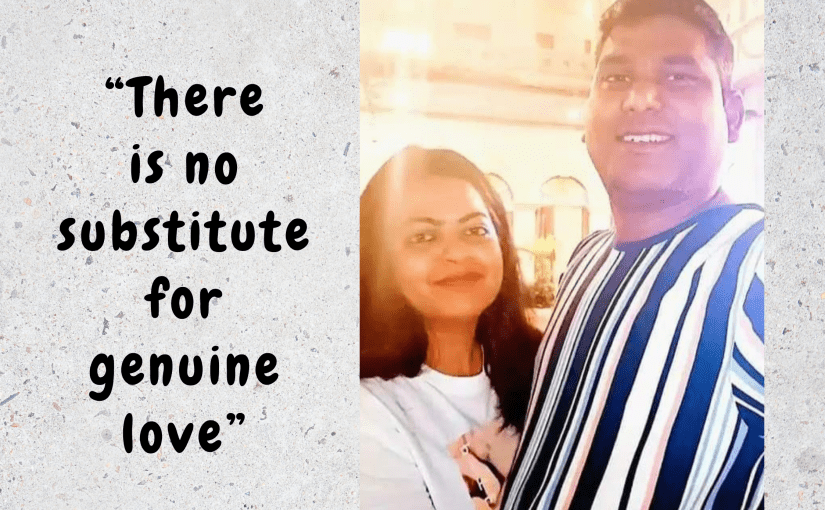
It is always astonishing how love can strike. It happened in the case of Vinay Jaiswal and Pooja Choudhary. The two got married in 2012, but mutually and amicably separated in 2018 as they felt they couldn’t connect. Their hearts, however, remained connected even after the separation. So, when Vinay suffered a heart attack in August last year, his ex-wife came running to take care of him. Then something unusual happened.
…..
Swati Subhedar
It sometimes feels as if someone sitting up there has already written the script of our lives—from start to finish. It’s sacrosanct; we can’t change or rewrite it. We only get to read this script in episodes—some pleasant, some unpleasant—yet we move on from one episode to the other, mechanically, as if that is the only way. But sometimes, some episodes shake our very core, and we are forced to take a pause to reflect, realign and restart.
On August 20 last year, Delhi-based Vinay Jaiswal went to the local market to run errands. A local shopkeeper was selling USB cables at a discounted rate. Vinay did not need one but bought one nevertheless and asked the shopkeeper if he would take it back in case it did not function properly. Petty things we bargain for, not knowing what tragedies await us.
The next day, Vinay’s heart malfunctioned. He suffered a cardiac arrest. An Angiogram revealed 97% blockage. Open-heart surgery followed. The health scare came as a rude shock for Vinay who always thought he was doing everything to be fit and healthy. The first step was acceptance and the next was recuperation. But he wasn’t alone. Pooja Choudhary stood by him, like a rock.

To know who Pooja is, we will have to flip back a few chapters.
Vinay and Pooja got married in 2012. Pooja hails from Patna, but because of her father’s transferable job, she lived in many cities all over the country. Vinay, on the other hand, spent most of his life in Jaunpur and Prayagraj, Uttar Pradesh. He was working with a central public sector undertaking in Delhi when he sent a profile request to Pooja on a matrimonial site. The two families met, and the two got married soon after. In hindsight, it was a mistake.
“After our wedding, when I came to Ghaziabad to live with Vinay, there was friction right from the beginning. We realised we came from two entirely different cultures and backgrounds, and we had nothing in common other than our caste. While we were always respectful towards each other, we realised very early on that probably we were not made for each other and decided to part ways amicably in 2013 after doing everything that we could do to save the marriage,” recalls Pooja.
In 2018, the day of the divorce was an emotional roller coaster for Pooja. She decided she would not sign the divorce papers, in case Vinay stepped back. There was no explanation for this feeling, she says. But it was not to be. It was destined to happen. The same night, the two had dinner together, and respectfully said goodbye to each other. They kept in touch, on and off, over the phone.
Until August 2023.
There was no response from Vinay for a few days. When Pooja learnt about his cardiac arrest and surgery, she came running to Ghaziabad. Vinay was in the ICU. When she saw him lying there, their eyes met, and their stars realigned.
For the next two months, Pooja took care of Vinay. Despite the bitter experience of the past, there was no malice. A strong emotional bond developed and they two decided to give each other one more chance.
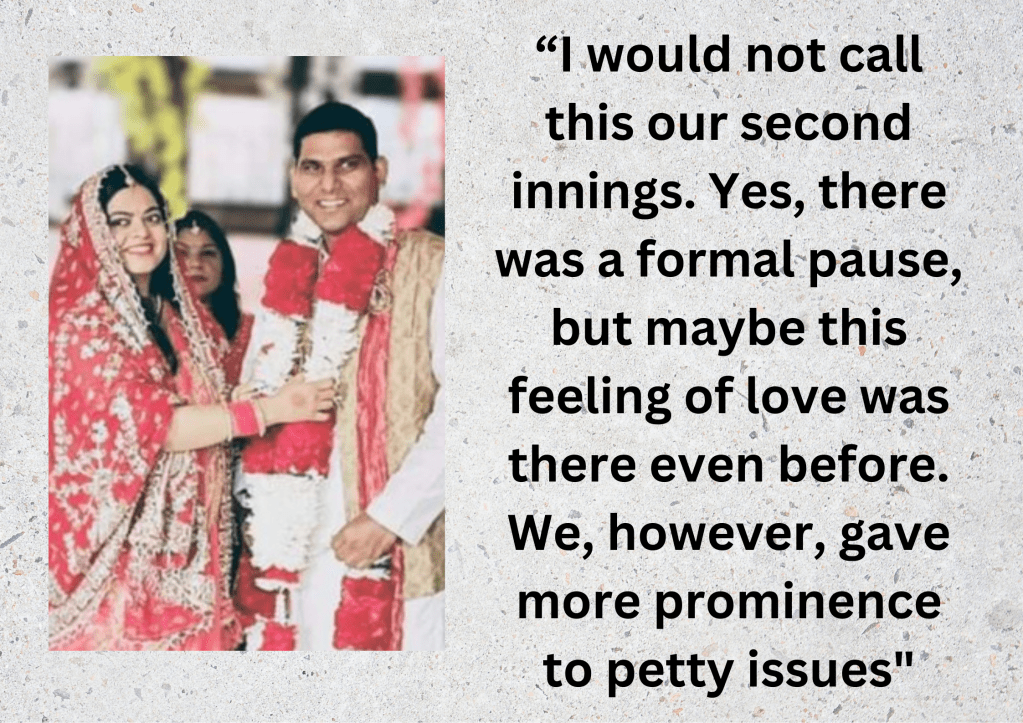
In November 2023, five years after their divorce and two months after they reconnected, they decided to get married.
What changed?
“I would not call this our second innings. Yes, there was a formal pause, but what we feel for each other now, this feeling of love was probably there before also. But we gave more prominence to petty issues when we should have spent time trying to understand each other. We had to spend 11 years apart to realise this, and to bring us closer, death had to come knocking to give a new lease of life to our relationship,” says Vinay.
In all these years Vinay learnt the actual meaning of love—to be emotionally attached to each other, trust one another and support each other in every situation. It takes years for a strong bond to develop, and it can only happen if love is given an opportunity to flourish constantly. “Often, we understand the true meaning of love only after a loved one leaves. It should never come to this stage,” he says.
Based on his past experience, Vinay feels one should think a thousand times before falling in love, committing to someone or getting married, especially in today’s time and age when there are multiple platforms like dating apps and social media that help people to connect. “When you commit to someone, your entire life is at stake. Therefore, it makes sense to take things slowly, befriend one another, let true love blossom on its own, and then go to the next stage. Yes, things have changed, and old definitions of love and relationships do not apply now, but the bottom line has remained the same—your companion should be your only constant. Hence choose wisely. There is no substitute for genuine love,” he says.
Communication gap kills relationships. “Even after we separated, we kept in touch and talked to each other. This probably is the reason why our hearts remained connected. Present-day technology and several other distractions are often blamed for emotional detachment among couples. These are beautiful mediums and if we learn to use them effectively, technology can actually bring couples closer,” says Vinay.
Today, when more and more marriages are getting entangled in the web of separations and divorces, Vinay feels people, especially youngsters, are losing faith in the institution of marriage. While one must walk out of claustrophobic, emotionally damaging and unsafe wedlocks, marriages can be saved if they are standing firm on the strong foundation of love. “A marriage is a work in progress. Married couples must constantly keep nourishing their love to retain its freshness,” he says.
A lesson both Vinay and Pooja learnt the hard way.
But when the two decided to get married again in November 2023, their families were relieved and ecstatic. “Though we gave short notice, all those who love us and care about us came. This time, there was no pomp or show. It was a simple wedding. And it made us wonder why we spent so much money the first time. Instead of splurging on unnecessary things, we should have invested quality time in knowing and understanding each other instead,” says Vinay.
When they decided to get married, they didn’t realise they would end up becoming an endearing media story. While the lawyer who nullified their divorce decree told them that it was the first time in his career that he was seeing a couple remarrying years after divorce, the two were very casual about it. It was only after they posted their story on their respective Facebook pages, that they turned into a viral media story. Many publications, TV channels and websites got in touch with them so that they could tell their unusual love story to the world.
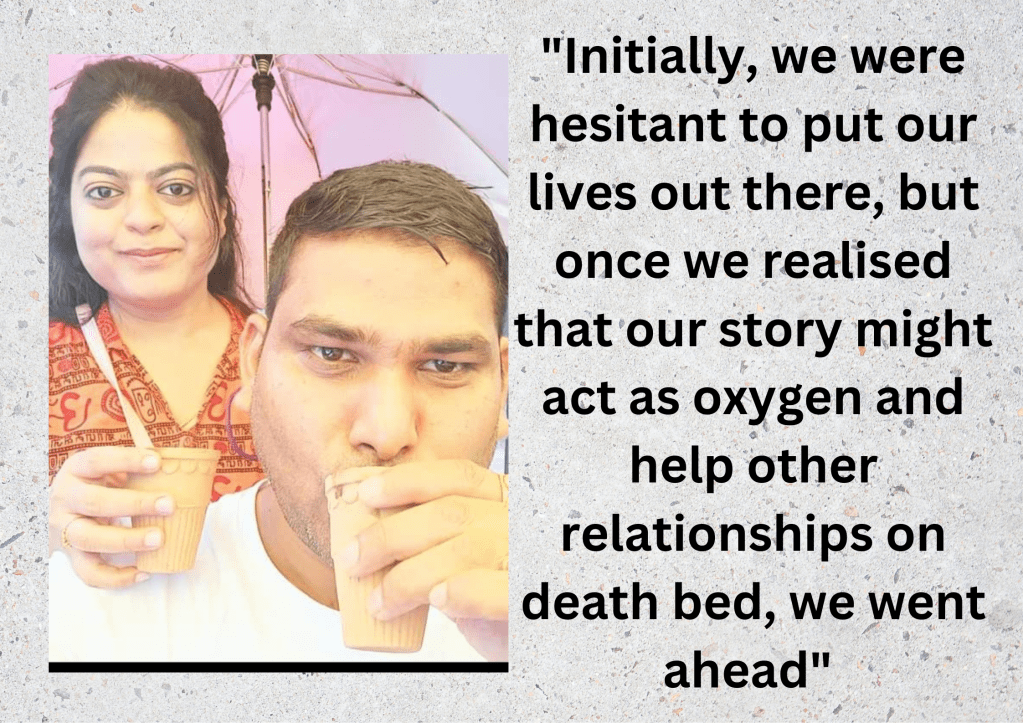
“Initially, we were hesitant to put our lives out there, but once we realised that our story might act as oxygen and help other relationships on death bed, we went ahead. We will be delighted if through our story we are able to save a relationship, help broken hearts to mend or couples to reunite. “For us, that is more important than our story going viral,” says Vinay.
Also read: Meet single mom Shital Shah and her two adopted daughters

 The Good Story Project